Career advice · Job search · Job search tools
Generative Engine Optimization Is Becoming a Job
Companies want to know why an AI assistant recommends a competitor and not them. That question is turning into a role, and nobody has named it yet.
Rivaldo A.
August 26, 2026 · 12 min read
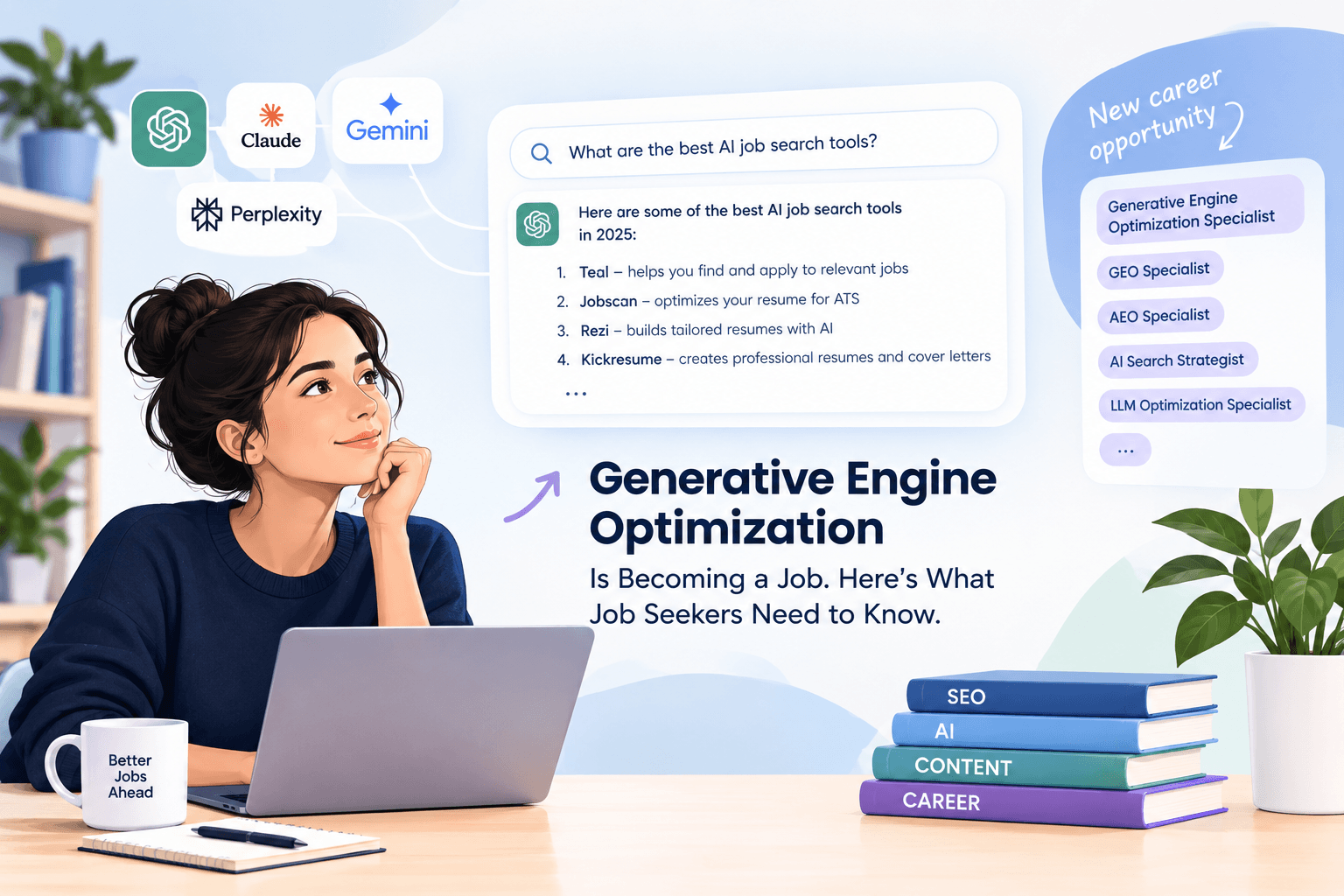
Somebody looking for a project management tool used to open Google, scan a page of results, and click three of them. A growing number of them now ask an assistant instead, read the four products it names, and never see a search results page at all.
For the companies that were not named, this is a problem with no obvious owner. Marketing tracks rankings. Product tracks signups. Nobody in the building is responsible for whether a language model mentions the company when someone asks a question it should be the answer to.
That gap is starting to become somebody's job.
What is generative engine optimization?
Generative engine optimization, usually shortened to GEO, is the practice of trying to make a brand, product or piece of content appear inside answers produced by AI systems.
Traditional SEO aims at a results page. You want your link in the top few positions when someone searches a term, and success is measured in rankings, clicks and impressions.
GEO aims at the answer itself. There may be no list of ten links. There may be one paragraph naming three companies, with two small citation markers. Success means being one of the three.
Consider someone asking an assistant which AI job search tools are worth using. Google returns a page of articles and comparison sites, and the reader chooses. An assistant returns a short recommendation, sometimes with sources, sometimes without. The set of options has been narrowed before the person has seen anything.
The shift is real without being complete, and the honest numbers show both halves. A Bain survey of 1,500 consumers found that 56% still mostly or always default to a search engine, against 16% who mostly or always start with a chatbot. A minority behaviour at the scale of today's assistants is still an enormous number of questions answered without a results page.
Among job seekers the adoption is further along. Employ Inc.'s 2025 Job Seeker Nation Report, based on more than 1,500 US adults, found that 69% of applicants now use AI to find or match with listings.
Companies noticing this have started asking questions their existing analytics cannot answer:
- Why did the model mention us in one phrasing of the question and not another?
- Which pages is it drawing from when it describes our category?
- Which competitors appear more often, and what do their sources have in common?
- Has any of this changed since last month?
None of those questions belong cleanly to an SEO manager, a content lead or a product marketer. Someone has to own them.
Why this is creating new work
Three things are happening at once, and together they add up to a role.
Discovery is shifting. When a share of buying research moves into conversations with assistants, visibility inside those conversations becomes commercially relevant. A company can hold its rankings and still lose ground because it stopped being named.
The measurement does not exist yet. A citation inside a chat answer usually sends no referrer. It does not appear in a rank tracker. It shows up, if at all, as unattributed direct traffic. So a company that wants to know how it is doing has to go and test, deliberately and repeatedly.
The answers move. Ask the same question twice, in two phrasings, across two models, and you can get three different sets of recommendations. Understanding that variation is closer to research than to a monthly reporting task.
This work is genuinely new, and it is worth being clear about its size. There is no established profession here yet. What exists is a real business problem, a growing number of people being asked to handle it, and a set of job titles that have not settled down.
What a GEO or AEO specialist actually does
Stripped of the terminology, the day-to-day work looks like this.
You build a list of the questions your buyers actually ask, then run them across several assistants and record what comes back. Not once, but on a schedule, because the answers drift.
You note who gets mentioned. If competitors appear consistently and you do not, you look at what the models are citing when they describe your category, and what those sources have in common.
You then work on the content, usually with the people who already own it. That means clearer structure, direct answers to specific questions, claims stated in a form that can be quoted, and information that can be verified elsewhere.
You report on it. Marketing wants to know whether visibility is improving. Product wants to know how the company is being described, because a model summarising your product inaccurately is a product problem as much as a marketing one.
The role sits at the meeting point of SEO, content strategy, data analysis and a working understanding of how language models select and reuse sources. It suits someone comfortable running structured experiments and reading the results honestly.
GEO, AEO and SEO: how the terms differ
Three labels circulate, and they overlap.
SEO covers traditional search engines. The goal is ranking on a results page.
AEO, answer engine optimization, describes making content easy for an answering system to understand, extract and reuse. It applies to featured snippets and voice assistants as much as to chat interfaces.
GEO, generative engine optimization, focuses on visibility inside answers generated by large language models.
In practice, companies use these terms loosely and often interchangeably. Somebody advertising for an AEO specialist and somebody advertising for a GEO specialist may want the same person. Treating them as three separate disciplines with fixed boundaries would misread a field that has not standardised yet.
For a job seeker, that ambiguity matters more than the definitions, and section seven comes back to it.
The tools behind this work
Because none of this is visible in standard analytics, a category of tooling has grown up around measuring it. These products generally do some combination of running queries across multiple models, recording whether a brand is mentioned, tracking which sources are cited, and watching how all of that changes over time.
As this field develops, teams increasingly rely on such tools rather than manual spot checks. AEOBoost is one example: it scores a site against a set of AI-readiness criteria and tests how different assistants respond to queries about a brand, which gives a team something measurable to work from instead of impressions.
Whichever tool a company chooses, the underlying skill is the same. Knowing what to test, and being able to tell a real change from noise, matters more than the software.
It is worth showing what such a test actually returns, so here are our own results. In August 2026 we had FutuRole audited this way: three queries a job seeker might plausibly ask, run across ChatGPT, Claude, Gemini and DeepSeek, twelve tests in total. The queries were "best AI job search assistant", "best AI tools for job seekers" and "Chrome extension job search copilot".
FutuRole was cited in none of the twelve. Teal and Jobscan appeared consistently. On the technical side the crawl found no access problems at all, which is the part companies usually worry about, but scored authorship signals at 30 out of 100 and content freshness at 40, mostly for the unglamorous reasons: no named authors, no organisation schema, no visible publication dates.
That combination is common and instructive. The pages were readable, indexable and reachable by every AI crawler tested, and still not selected. Being available and being chosen are different things, and the distance between them is the work this article describes. It is also why this piece carries a byline and a date, which the first version did not.
What skills the work requires
The encouraging part for career changers is that most of the required background already exists in adjacent roles.
SEO fundamentals still apply. Search intent, information architecture, technical crawlability and content quality all carry over, because the systems generating answers are reading the same web.
Content strategy matters more than it did. Content written to rank and content written to be quoted are not identical. The second needs clear structure, specific claims and answers placed where they can be extracted.
Some data literacy is necessary. You are collecting observations across models and phrasings, looking for patterns, and reporting on movement. Spreadsheets are usually enough. Statistics beyond averages and trends rarely are.
You need a working understanding of how language models use sources: what makes a passage quotable, why some claims get repeated and others ignored, how retrieval affects what a model can cite. This is learnable from documentation and experimentation.
Prompt design and testing come into it, though not in the creative sense. The skill is designing a consistent set of queries that can be re-run and compared.
Writing helps throughout, both for the content itself and for explaining findings to people who will not run the tests themselves.
Notably absent from that list: machine learning engineering. You do not need to train models to work on how they cite sources. Someone with a background in SEO, content, marketing analytics or technical writing is closer to this work than someone with a research background in AI.
What job titles to search for
This section is the practical one, because searching for the wrong string is the most common way to miss these roles entirely.
The same job is currently advertised under many names:
- Generative Engine Optimization Specialist
- GEO Specialist
- AEO Specialist
- Answer Engine Optimization Specialist
- AI Search Optimization Specialist
- AI Search Strategist
- Generative Search Strategist
- LLM Optimization Specialist
- AI SEO Specialist
- AI Search Consultant
Some companies avoid new terminology altogether and fold the work into an existing SEO or content role, describing it only in the responsibilities. Searching for "GEO Specialist" alone will miss those listings completely, and they may be the majority.
A more reliable approach is to search the responsibilities rather than the title. Phrases like "AI search visibility", "LLM citations", "answer engines" or "brand visibility in AI" appear in job descriptions whose titles give no hint that this is the work.
These roles are starting to appear
Job titles around AI search and generative engine optimization are beginning to show up across the market, although the terminology varies significantly between companies and the volume is still small compared with established SEO roles.
FutuRole tracks live openings across markets and roles, which makes this kind of emerging category easier to watch than it would be through a single job board. When a field is new and the naming is unsettled, seeing how demand moves matters more than any individual listing.
If this career path interests you, watch a set of titles rather than one keyword, and check the responsibilities of roles that look adjacent. FutuRole can help you surface relevant openings across AI, SEO, content and marketing, including the ones whose titles have not caught up with the work.
How to prepare for this now
Nine steps, roughly in order.
- Learn SEO properly. Not tactics, fundamentals: how content is discovered, structured and evaluated. Everything else builds on it.
- Understand how assistants use sources. Read how retrieval works and why some content gets cited. You do not need the mathematics.
- Run your own tests. Pick a category you know. Ask five assistants the same ten questions. Record what gets recommended.
- Vary the phrasing deliberately. Change one word at a time and watch what happens to the recommendations. This teaches more than any article.
- Look at what gets cited. When sources are shown, open them. Look for what those pages have in common structurally.
- Build a small project. Take one site, measure its visibility, change something specific, measure again. Even a modest result is evidence.
- Write down what you find. A short public write-up of an experiment is a portfolio in a field where nobody has ten years of experience.
- Follow the companies working on this. Tool vendors, agencies adding the service, in-house teams publishing about it.
- Search several job titles at once, and save the searches so new listings reach you.
Someone doing this consistently for a few months would be more prepared than most applicants for a role that barely existed two years ago.
Is this a real career or a passing label?
Both answers are partly right, and it is worth being honest about which parts.
The field is young. Job titles are inconsistent. A good deal of this work will probably be absorbed into existing SEO and content roles rather than becoming a separate profession, in the way that mobile optimization became part of web development instead of a permanent standalone job.
Some companies, particularly those whose customers research through assistants, will create dedicated roles. Others will add a line to an existing job description.
The business problem behind it is not in doubt. Companies want to know how they appear when people ask AI for recommendations, and that question will keep needing an owner whatever it ends up being called.
New technologies routinely create work before they create job titles. The people who learned search marketing in 2005, or social media strategy in 2010, were not following a defined career path. They were paying attention early to a problem companies had just started to have.
The name may change. GEO, AEO, AI search, LLM optimization: nobody has settled on one. The underlying problem is already here, and for anyone thinking about where the next few years of their career go, it is worth watching now rather than once the titles are standardised.
Rivaldo A. is a co-founder of FutuRole, where he works on positioning and growth. The audit described above was run on FutuRole's own pages in August 2026 using the tool named in this article, and the results are published here unedited.