Job search · Job search tools · Career advice
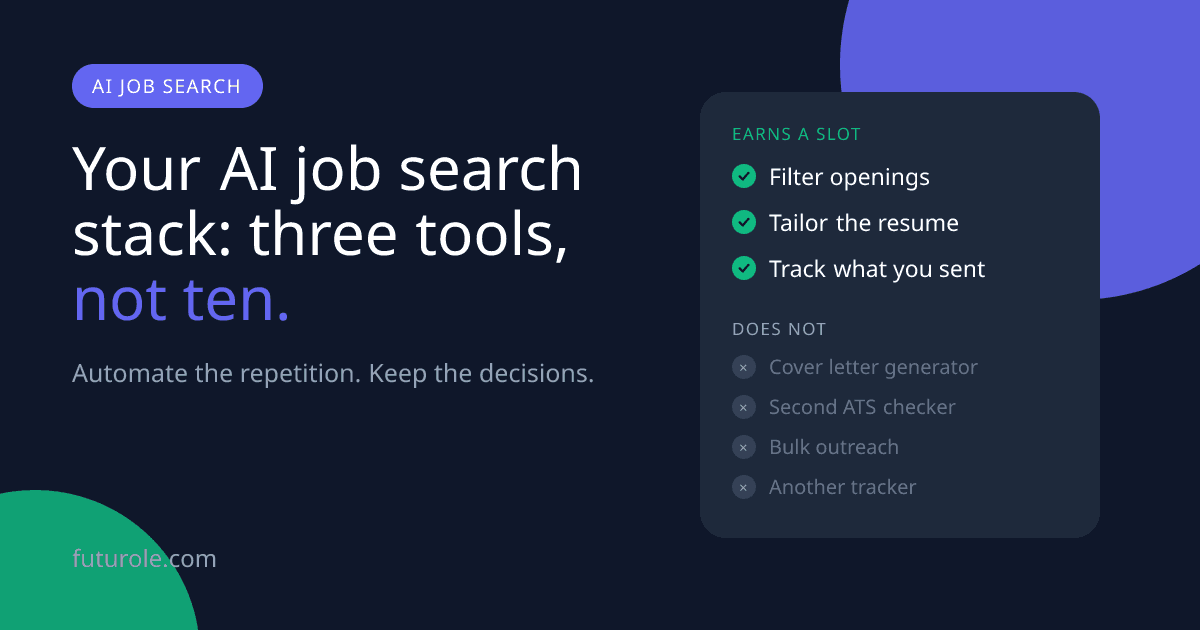
Your AI Job Search Stack: Three Tools, Not Ten
Most AI job search stacks fail by addition, not by picking the wrong tools. Here is the test a tool has to pass before it earns a slot in yours.
FutuRole Team
August 22, 2026 · 6 min read
Count the tabs open during your last application. A job board. A resume editor. An ATS checker. A cover letter generator. A LinkedIn search. A spreadsheet you stopped updating three weeks ago.
That is not a stack. That is six places to lose track of the same application.
The usual advice is to add the right tools. The more useful move is to work out which ones you can remove, because a job search stack is defined by what it leaves out.
One test decides whether a tool earns a slot
Every task in a job search falls into one of two buckets.
Repetition is work where the answer is already known and you are just producing it again. Typing your education history into a fourth Workday form. Reformatting the same resume. Checking whether a posting mentions a skill you have.
Judgment is work where the answer depends on you. Whether a role is worth your time. Which two projects best show what you can do. What to say to a hiring manager who has never heard of you.
AI is very good at the first bucket and unreliable in the second. So the test is:
Does this tool remove repetition, or does it remove a decision I should be making?
Tools that remove repetition give you hours back. Tools that remove decisions give you a generic application that reads like everyone else's, which is the opposite of the thing you need.
That test rules out most of what gets recommended, and it leaves roughly three jobs worth automating.
Slot 1: knowing which jobs are worth the effort
Reading 200 postings to find eight that fit is repetition. Deciding which of the eight to chase is judgment.
The part worth automating is the filtering: matching openings against your skills, your location, your salary floor and your deal-breakers, so you only read the shortlist.
Before any tool can do that, you have to state your criteria, and most people never write them down. Target roles, acceptable locations, salary floor, the requirements you will not compromise on. Without those, a matching tool just produces a different pile of postings.
It is also worth knowing where the openings for your profile actually are. Demand is not evenly spread, and the country you are searching in may simply have fewer roles than the one next door. Our hiring map counts live openings by country and role, and where should you work ranks markets against your own constraints, including whether the ads there are written in English or mention visa sponsorship.
Slot 2: closing the gap between your resume and the posting
Tailoring is the highest-leverage repetitive task in the search, because it affects both the software that parses your resume and the recruiter who skims it.
What is worth automating: finding the overlap between what the posting asks for and what you have already done, spotting the terms the posting uses that your resume does not, and catching formatting that parsers mishandle. Our free ATS scanner does the last part against a specific job description, and how to tailor a resume to a job description covers the method.
What is not worth automating: the claim itself. Never let a tool add experience you do not have. A resume that passes the filter and collapses in the first interview has cost you more than a rejection would have.
Slot 3: remembering what you did
This one is unglamorous and it is the slot people skip.
At twenty applications you can hold it in your head. At forty you cannot remember which resume version went to which company, who replied, or which follow-up is overdue. That is when good candidates start missing interviews they had already earned.
A tracker does not need to be clever. It needs to be the one you still use in week six. Whatever you pick, it should hold the application date, the resume version, the contact, the next action and its date.
What does not deserve a slot
Outreach at volume. AI can research a person's background and tighten your draft. Sending near-identical messages to fifty recruiters produces fifty ignored messages, not fifty conversations.
Answers you read. Generating likely interview questions from the posting and your resume is useful. Reading a polished generated answer is not preparation. Say it out loud, without the screen, until it sounds like you.
Volume for its own sake. A hundred applications to roles you do not want is not better than twenty to roles you do. Automation only pays when it is pointed at applications that were worth sending.
When you genuinely have a gap
Sometimes the missing piece is real, and the problem becomes finding one tool for one specific job without spending an afternoon on search results and affiliate roundups.
Browsing by category beats searching blind. PublishYourSaaS is a SaaS discovery directory that lists products by category and use case, which is a faster way to see what exists for a narrow problem than trying to guess the right search terms.
Discovery is not evaluation, though. Run anything you find through the same test: repetition or judgment. If it removes a decision you should be making, it does not go in the stack, however good the landing page is.
The whole stack, in five lines
- Filter openings against written criteria, so you only read the shortlist.
- Tailor each resume against the actual posting, and verify it parses.
- Apply, reviewing every submission before it goes.
- Reach out personally, to a small number of people who can tell you something.
- Track what you sent, to whom, and what is next.
Steps one, two and five are worth automating. Three and four are where you decide things, and that is exactly why they stay slow.
The point of the whole exercise
AI will not make a weak application competitive. It removes the repetitive work around the application, and what you do with the hours it gives back is the entire return.
Spend them on the things no tool does for you: researching the company properly, talking to someone who works there, practising out loud, and being honest about which roles are actually worth your week.
If you want the comparison of individual products rather than the argument for keeping the stack small, we maintain a longer list of AI job search tools worth using in 2026.