Career advice · Job search
Working Remotely From Another Country
A remote offer does not make a country legal, payable or rentable. Four institutions have to say yes before the move works, and each wants proof.
FutuRole Team
August 25, 2026 · 8 min read
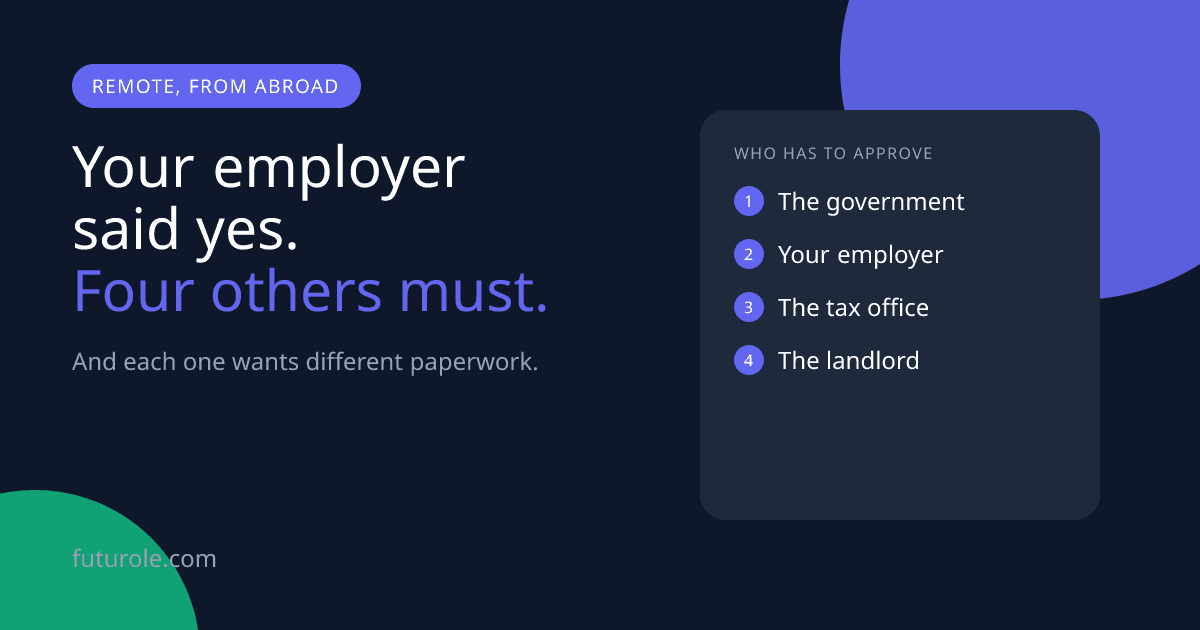
The job says remote. You read that as "anywhere". Almost nobody involved in the transaction reads it that way.
A remote contract is an agreement between you and one company. Moving to another country to perform it involves at least four other parties, and each has its own rules, its own timeline and its own paperwork. None of them care that your manager said yes.
Working out which four, and what each one wants, is the whole job before you book a flight.
One thing does repeat across all of them. Each party wants evidence that money reaches you regularly, and each wants it in its own format: a consulate for the visa income threshold, an employer for onboarding, a tax office for the filing, a letting agent for the tenancy. Bank statements end up doing most of that work, which is why getting them into a readable shape early saves the same effort four times over. A converter such as BankStatementLab turns statement PDFs into a spreadsheet you can total and check, and the sections below note where each party asks for what.
The four gates
Everything that goes wrong with an international remote move traces back to one of these:
- The government decides whether you may be in the country and work from it.
- Your employer decides whether it can legally pay someone sitting there.
- The tax authorities, sometimes two of them, decide who gets taxed on what.
- The landlord decides whether you get somewhere to live, and asks for proof of things the first three have not settled yet.
They are not independent. The landlord wants proof of income, which depends on how the employer pays you, which depends on your immigration status. The order matters, and it is usually discovered backwards.
Gate 1: are you allowed to be there?
A tourist visa is not a work permit, and a remote salary paid from abroad does not change that. It is widely ignored and occasionally enforced, and the consequences fall on you rather than your employer.
The legitimate routes are narrower than the internet suggests. Around fifty countries now issue some form of digital nomad or remote work visa, generally requiring proof of employment, a minimum monthly income and health coverage. Some are genuinely easy. Some take four months.
The income requirement is where applications stall. Proving it usually means bank statements covering three to six months, and consulates expect the figure to be easy to read rather than buried in a year of transactions.
Check three things before anything else: whether the visa exists for your nationality, what monthly income it requires, and how long processing takes. That third number sets the timeline for the entire move.
Gate 2: can your employer actually pay you there?
This is the one candidates skip, and the one that most often kills the plan late.
Employing someone in another country usually requires a compliant arrangement of some kind: a local entity, a local registration, an employer of record, or another structure permitted in that jurisdiction. What is available depends on the country and on how your company is set up. If your employer has nothing in place where you are going, these are the usual routes:
- Employer of record. A third party employs you locally on your company's behalf. Clean, common, and it costs your employer several hundred a month, so it needs approving before you commit.
- Contractor. You invoice them. Simpler for the company, and it moves tax, social contributions, paid leave and job protection onto you. Read what you are giving up before agreeing.
- They say no. Plenty of companies allow remote work strictly within countries where they already operate. Ask early, in writing.
Ask this question before you resign from anything. "Can you employ me from Portugal?" has a different answer from "Do you allow remote work?", and only the first one matters.
Gate 3: tax, in two places at once
Spending more than 183 days in a country is often cited as the threshold, and it is one factor, but rarely the only one. Personal ties, where your permanent home is, where you actually perform the work, each country's own domestic rules and any tax treaty between them can all bear on the answer. Your home country may keep treating you as resident at the same time.
Double taxation treaties exist precisely so you are not taxed twice on the same income, but they do not apply themselves. You claim them, with documentation, usually in both countries.
Two practical consequences. First, your take-home changes, sometimes substantially, and the offer you accepted was quoted before that. Second, you will need an exit or residency filing in at least one country, and that has deadlines you can miss.
An hour with an accountant who handles cross-border cases costs less than one mistake here.
Gate 4: renting, where the paperwork lands
You arrive with a signed contract and assume that settles it. Then a letting agent asks for the last three months of bank statements, proof of income, a local guarantor and sometimes a local bank account you cannot open without an address you do not yet have.
This circle is the single most common frustration of an international move, and it is mostly a documents problem.
Bank statements cause the most trouble here, because what a bank gives you and what a letting agent will accept are rarely the same thing.
Bank statements can be difficult to organize when income is spread across several accounts or statement formats. BankStatementLab converts bank-statement PDFs into structured Excel or CSV files, helping applicants review deposits and prepare a clear supporting summary. The converted file is a working copy; applicants should still provide the original bank-issued statements in the format requested by the landlord or letting agent.
The full list of what tends to be asked for:
- Employment contract, often translated, sometimes certified
- Recent payslips, typically three months
- Bank statements, typically three to six months
- Proof of address, from the country you are leaving
- Tax returns, more often for contractors than employees
Two things make this stage easier. Gather every document while you still have easy access to your old accounts, employer and address, because requesting them from abroad is slow. And ask the agency directly what format they accept, in writing, before you spend a weekend assembling the wrong thing.
Getting paid, and where it lands
If you are employed through a local entity or an employer of record, you will usually need a local account, which brings you back to the address problem. Digital-first banks are the common workaround: many open accounts on a passport and a temporary address, then upgrade once you have a permanent one.
If you are a contractor billing in another currency, the exchange spread is a real line in your budget. A poor rate applied monthly to a full salary costs more per year than the subscriptions people cancel to save money.
Insurance, which nobody thinks about until they need it
Moving abroad can affect your public healthcare coverage at home, though it does not automatically end it in every situation. It depends on the country, on how long you are away and on whether any reciprocal arrangement applies. Check before you leave rather than after. A digital nomad visa usually requires private cover as a condition of issue in any case.
Check what your policy does about pre-existing conditions, whether it covers repatriation, and whether it is accepted by hospitals locally rather than only reimbursing you afterwards.
Before you say yes
Four questions, all of them for the employer, all of them best asked in writing after the offer and before you accept:
- Can you employ me from that country, and through what structure?
- Does my salary change if I move, and is it reviewed against local rates?
- Which time zone am I expected to overlap with, and for how many hours?
- Is there any relocation or visa support?
The last one is negotiable more often than people assume, and asking costs nothing at that point in the process.
The check worth doing first
Before any of this, it is worth knowing whether the country you have in mind is one where your profile is actually in demand, and how much of that market is genuinely remote.
Our hiring map counts live openings by country and role with the remote share of each market, and where should you work ranks markets against your own constraints, including whether the ads there mention visa sponsorship or relocation support. If you are still preparing applications, the free ATS scanner checks your resume against a specific posting before you send it.
Moving abroad for remote work is very doable. It is just not a decision made by your employer alone, and the sooner you treat it as four separate approvals, the less likely one of them is to arrive too late.