Resume · Job search · Interview
Resume for Microsoft: What Hiring Managers Actually Look For in 2026
Microsoft ranked #4 on Forbes' Best Places to Work in 2026 and receives millions of applications yearly. Here's the exact resume format, keywords, and growth mindset evidence that gets candidates past screening and into interviews.
BlogWriter Team
May 10, 2026 · 9 min read
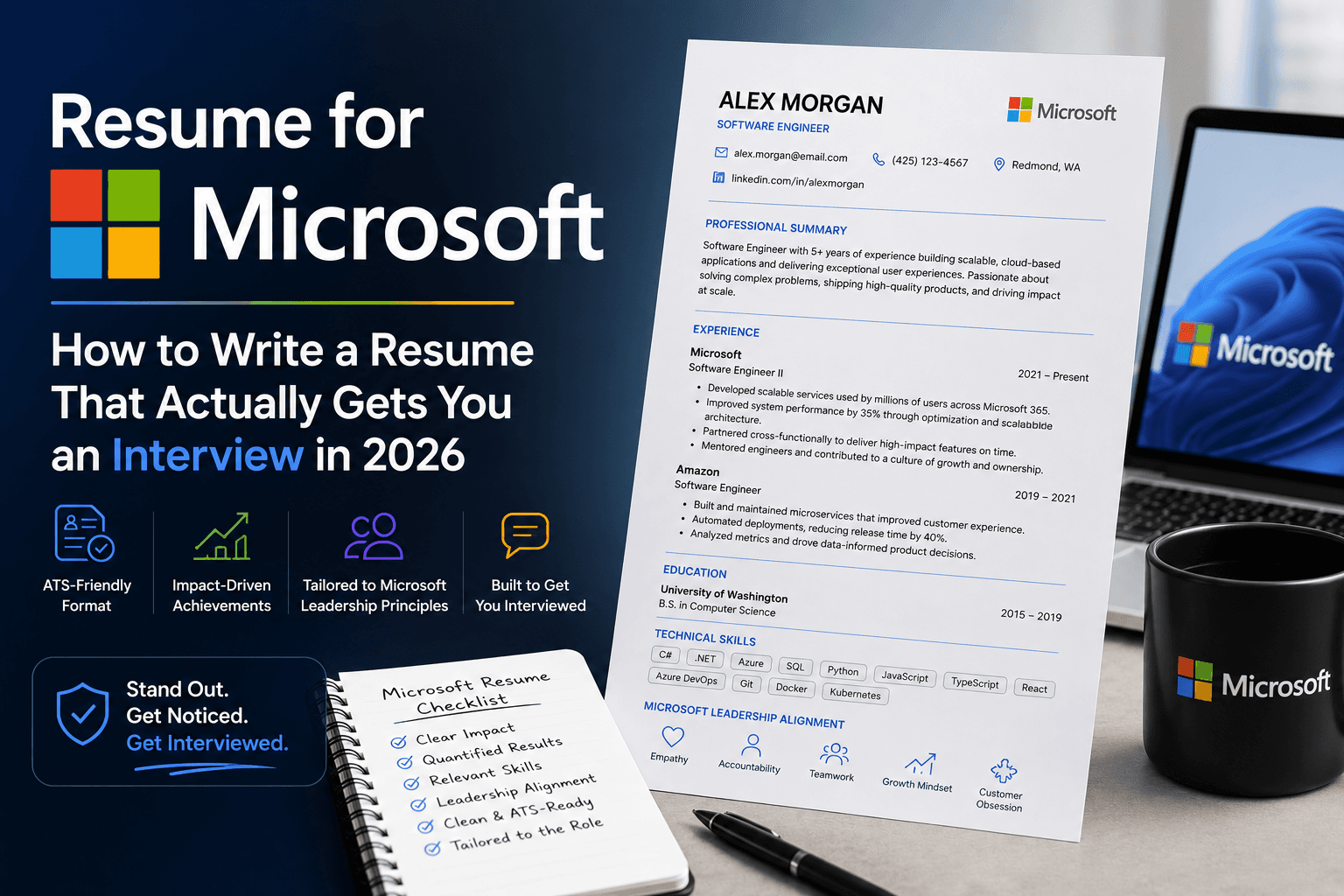
Microsoft ranked #4 on Forbes' Best Places to Work in 2026 and #1 on Newsweek's Most Reliable Companies list, ahead of IBM, Amazon, and Google. With over 220,000 employees globally and a market capitalization that makes it one of the world's most valuable companies, Microsoft is — and has been for decades — one of the most sought-after employers in tech.
It's also one of the most misunderstood from a hiring perspective.
Most candidates approach Microsoft with the same strategy they'd use for Google or Amazon — keyword optimization and impact-focused bullets — and miss the single most important thing Microsoft hiring managers evaluate: growth mindset. Satya Nadella's transformation of Microsoft since 2014 is built on Carol Dweck's growth mindset framework, and it permeates every aspect of how the company hires, evaluates, and promotes people.
This guide covers everything: how Microsoft's hiring process works, what the growth mindset looks like on a resume, the keywords that matter by role, and the specific structure that gets candidates past Microsoft's screening systems in 2026.
How Microsoft's Hiring Process Works in 2026
Stage 1 — ATS Screening: Microsoft uses Workday for most corporate and technical roles. The system parses your resume for keyword alignment, minimum qualification matching, and formatting compatibility. Resumes with ATS issues — multi-column layouts, tables, graphics — score lower than clean single-column documents with equivalent content.
Stage 2 — Recruiter Phone Screen (30 minutes): A Microsoft recruiter reviews your background against the role requirements and asks 2-3 behavioral questions. They're specifically looking for growth mindset signals — examples of learning from failure, seeking feedback, and developing new capabilities intentionally.
Stage 3 — Technical or Skills Screen (45-60 minutes): For technical roles, this is a coding or system design screen. For non-technical roles, it's often a case-based exercise or role-specific scenario. This stage filters candidates who passed the resume review but can't demonstrate their skills in real time.
Stage 4 — The Interview Loop (4-5 interviews): Microsoft's loop includes both technical/role-specific interviews and behavioral interviews. As of 2025, Microsoft introduced an AI-assisted interview preparation tool for candidates, reflecting their commitment to using their own AI products internally.
Stage 5 — "As Appropriate" Review: Senior positions go through an additional review by a senior leader. This is the Microsoft equivalent of Amazon's Bar Raiser process — an additional check to maintain calibration across the organization.
The Growth Mindset: What It Means for Your Resume
Satya Nadella describes Microsoft's cultural shift as moving from "know-it-alls to learn-it-alls." This isn't corporate language. It's a specific, operationalized framework that Microsoft hiring managers are trained to evaluate.
A fixed mindset resume looks like this:
- All bullets describe successful outcomes with no mention of learning, iteration, or course correction
- Career history shows stable progression with no evidence of taking on unfamiliar challenges
- Language reflects confidence in established expertise with no evidence of reaching beyond it
A growth mindset resume looks like this:
- Bullets include not just what succeeded but what was learned and applied
- Career history includes examples of taking on roles or challenges outside existing comfort zones
- Language reflects curiosity, iteration, and development over time
The growth mindset bullet:
Before (fixed mindset):
Led the product launch that generated $4.2M in revenue
After (growth mindset):
Led initial product launch that missed target by 22%; diagnosed the gap through 30 customer interviews, rebuilt the onboarding flow, and re-launched to generate $4.2M in revenue — 140% of the original target
The second version demonstrates impact AND demonstrates that you learn, iterate, and don't paper over failures. That's the growth mindset signal Microsoft is looking for.
You don't need to do this for every bullet — leading with impact is still correct. But 2-3 bullets that show the learn-iterate-succeed cycle are powerful differentiators at Microsoft that don't matter at most other companies.
The Microsoft Resume Format
Microsoft's ATS (Workday) has the same technical preferences as Amazon's:
- Single column — multi-column layouts break the parser
- Standard fonts — Calibri (Microsoft's own font, appropriate signal), Arial, or Georgia at 10-12pt
- No graphics or images — the ATS reads text, not visuals
- Contact in the body — not in headers or footers
- PDF format for most roles
- Length: 1-2 pages. Microsoft recruiters have explicitly stated that 2 pages is the outer limit they read carefully. Beyond 2 pages is scanned at best.
One Microsoft-specific note: Calibri is Microsoft's default font and is a subtle cultural fit signal. It's not required, but using it is never wrong.
The Microsoft Bullet Formula
Microsoft's hiring framework evaluates candidates on impact at scale and growth mindset. Your bullets should address both.
The formula: [Action verb] + [what + scale/context] + [result] + [optional: what you learned or did next]
Examples across roles:
Software Engineering: Before: "Built features for the Azure portal" After: "Architected and shipped a real-time alerting system for Azure Monitor serving 180,000 enterprise customers, reducing mean time-to-detection for critical incidents from 14 minutes to 3 — later promoted to GA feature after 94% positive feedback in preview"
Product Management: Before: "Managed the roadmap for the Teams collaboration features" After: "Prioritized and shipped 4 Teams features in H1 2025, increasing daily active users by 2.1M and reducing user-reported friction in the meeting scheduling flow by 38% — discovered through NPS analysis I introduced to the PM process"
Sales (MCAPS): Before: "Exceeded sales quota by 15%" After: "Exceeded Azure commercial sales quota by 15% ($2.3M over target) by building an executive relationship framework that accelerated 3 enterprise deals stuck in legal review for 6+ months — process later adopted by the regional team"
Operations: Before: "Improved supply chain efficiency" After: "Reduced order processing lead time by 31% across a 12-country supply chain by identifying a sequencing bottleneck that had been attributed to vendor delays — actual root cause was an internal approval workflow no one had mapped before"
The last example — finding a problem everyone else missed — demonstrates "Are Right, A Lot" in Amazon's language and "growth mindset" in Microsoft's. The framing matters for each company.
Microsoft-Specific Keywords by Role Category
Software Engineering / Cloud (Azure)
Azure, C# / .NET / Python / TypeScript, distributed systems, cloud-native, microservices, Kubernetes, AKS, Azure DevOps, CI/CD, GitHub, REST APIs, system design, scalability, reliability engineering, live site incidents, SLA / SLO, AI integration, Copilot
Product Management
product vision, OKRs, roadmap, customer obsession, growth metrics, DAU / MAU, Microsoft 365, Azure, Teams, partner ecosystem, enterprise customers, go-to-market, data-driven, A/B testing, AI-powered features, Copilot integration
Sales (MCAPS — Microsoft Customer and Partner Solutions)
Azure consumption, cloud migration, enterprise agreements, quota attainment, solution selling, executive engagement, digital transformation, partner co-sell, Teams, Microsoft 365, Dynamics 365, Salesforce, pipeline management, renewal rate
Data / Analytics
Azure Synapse, Power BI, SQL, Python, Azure Data Factory, Databricks, machine learning, data modeling, business intelligence, KPI reporting, DAX, semantic layer, data governance
Marketing
integrated marketing, demand generation, B2B marketing, event marketing, Dynamics 365 Marketing, content strategy, partner marketing, field marketing, campaign attribution, MQL / SQL, revenue marketing
HR / People Operations
organizational development, talent acquisition, performance management, Viva Insights, employee experience, DEI, learning and development, succession planning, workforce planning
Microsoft's Culture Signals: What to Embed in Your Resume
Beyond the growth mindset, three Microsoft-specific cultural signals increase your chances:
1. AI fluency. Microsoft has gone all-in on Copilot and AI integration across every product. Candidates who demonstrate that they've used AI tools to improve their work — not just that they're "interested in AI" — are increasingly preferred. If you've used Copilot, Azure AI services, or any AI tools to meaningfully improve your output, make that visible on your resume.
2. Collaboration over individual heroics. Google's XYZ formula focuses on individual achievement. Microsoft's culture puts significant weight on cross-functional collaboration and making others better. Bullets that describe how you influenced others, developed team capability, or drove alignment across organizations resonate more at Microsoft than at most tech companies.
3. Long-term thinking. Microsoft rewards patience and systemic thinking over quick wins. Bullets that describe building foundations, creating frameworks others adopted, or making investments that paid off over time align with how Microsoft operates.
The Most Common Reasons Microsoft Rejects Resumes
Fixed mindset signaling. A resume with no evidence of learning from failure, no examples of taking on unfamiliar challenges, and no narrative of development over time reads as culturally misaligned at Microsoft — even if the technical credentials are strong.
Cloud skills gap. Microsoft's business is increasingly centered on Azure, Microsoft 365, and AI. Candidates without cloud or AI fluency are at a significant disadvantage even for non-technical roles. Demonstrating that you've worked with Microsoft's cloud products — even through certifications or side projects — addresses this gap.
Wrong level targeting. Like Amazon, Microsoft has a detailed leveling system (59-69 for senior individual contributors, 80+ for principal and partner-level roles). Applying consistently to roles significantly above your demonstrated level signals poor self-awareness and reduces your chances.
No quantification. Microsoft's hiring managers use the same evaluation framework as most major tech companies: they want evidence, not claims. A bullet that says "improved customer satisfaction" without a measurement is easy to dismiss. "Improved NPS by 14 points over two quarters, moving the product from the 38th to the 67th percentile in our segment" is evidence.
Tailoring Your Resume for Microsoft Quickly
Microsoft's Workday ATS is keyword-sensitive and processes a high volume of applications daily. The candidates who advance consistently are the ones who tailor their resume to each specific Microsoft role — not the ones who send a generic document and hope the breadth of their experience compensates.
FutuRole's AI Resume Engine tailors your resume to any Microsoft job posting in 60 seconds: it mirrors the JD's keyword set, reorders your bullets by relevance to that specific role, adjusts your summary to reflect the team's context, and exports an ATS-ready PDF. The ATS Scanner shows your match score before and after so you know you're submitting a competitive application.
For Microsoft specifically, also use FutuRole's Company Intelligence before any interview — it surfaces recent Microsoft announcements, product launches, and team-level news that allows you to demonstrate the "Learn and Be Curious" signal that Microsoft recruiters explicitly look for.
URL: futurole.com/blog/resume-for-microsoft
Tailor your resume for Microsoft in 60 seconds. Run your free ATS scan on FutuRole →