Job search · Resume
How I Used GPT and Claude to Land a Job in 25 Days (Full Step-by-Step Playbook)
The exact process, prompts, and daily system I used with ChatGPT and Claude to go from unemployed to signed offer in 25 days. Every prompt is copy-paste ready. No fluff, no theory — just the full playbook.
Futurole Team
May 10, 2026 · 23 min read
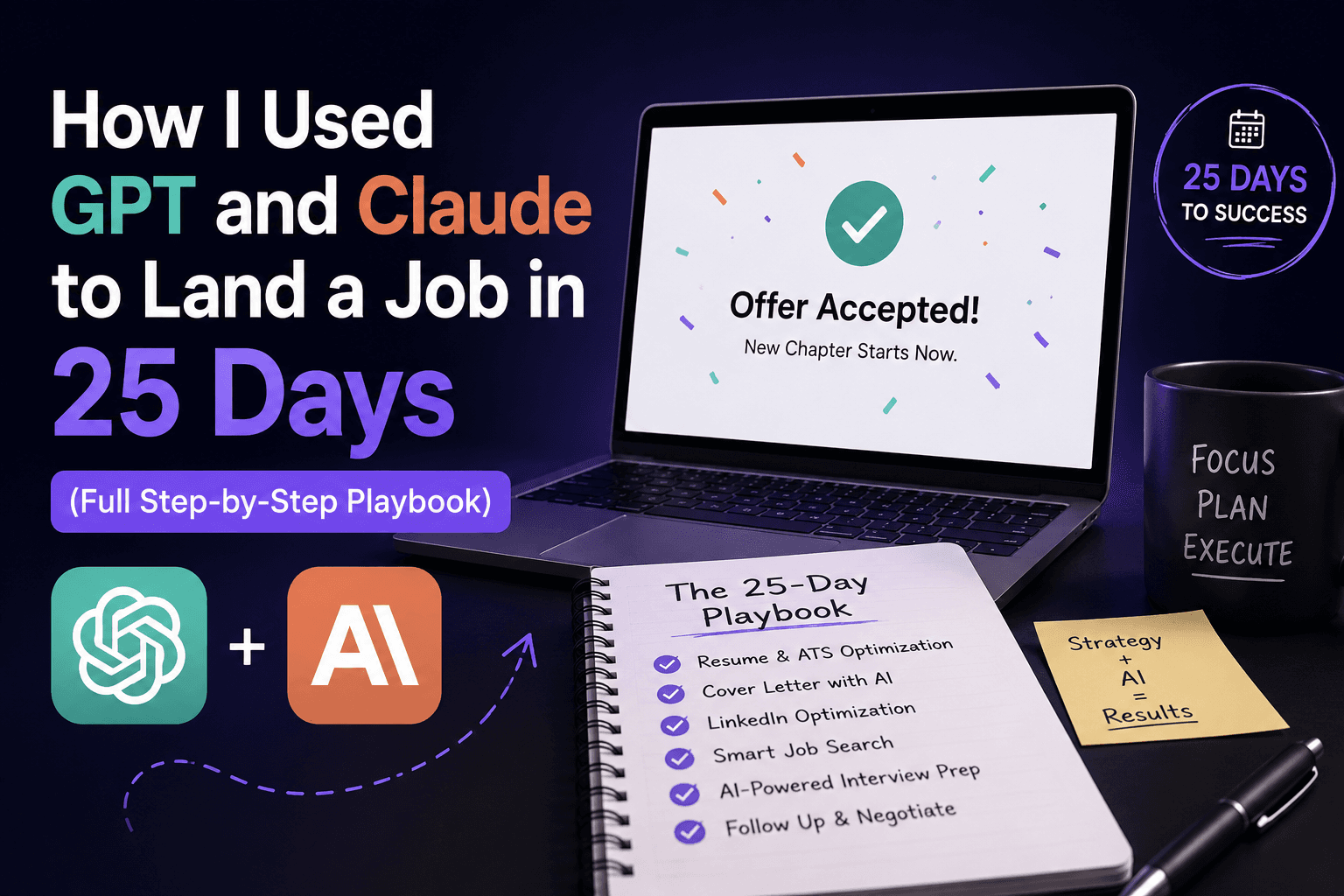
I want to be direct about what this article is: a complete, copy-paste-ready playbook. Not a motivational post. Not a "here are some tips." Every step has a real prompt you can use today. Every section has a concrete output you'll produce before moving to the next one.
I used this exact system to land a Senior Growth Marketer role after being laid off in February 2026. Twenty-five days from layoff to signed offer. Here is everything I did, in the order I did it.
Tools used: ChatGPT (GPT-5.4) and Claude (Sonnet) — both free tiers are sufficient for most of these steps. A paid plan speeds things up but isn't required.
Time investment: About 2-3 hours on Day 1-3, then 45-60 minutes per day for the remaining three weeks.
Let's go.
Before You Start: Two Rules That Make Everything Else Work
Rule 1 — AI is your editor, not your ghostwriter. The single biggest mistake job seekers make with AI is letting it write everything from scratch. Recruiters in 2026 are trained to spot AI-generated applications. A Resume Builder survey from late 2025 found that 53% of hiring managers said they'd rejected candidates suspected of using AI to write their entire application. The tell is obvious: generic phrasing, no specific details, a tone that reads like a Wikipedia entry.
Use AI to sharpen, quantify, and optimize content you already wrote. Your experience, your achievements, your voice. AI makes it better. It doesn't replace it.
Rule 2 — Context is everything. The difference between a mediocre AI output and a genuinely useful one is the quality of what you put in. Paste your full resume. Paste the full job description. Add constraints. The more real information you give Claude or GPT, the more targeted and usable the output. Generic prompt = generic output. Specific prompt = specific output you can actually use.
With those two rules established, here is the playbook.
Phase 1: Build Your Foundation (Days 1–3)
Step 1 — The Brutal Resume Audit (Day 1)
Before you change a single word of your resume, you need an honest diagnosis. Not from a friend who'll be polite about it. From an AI that will tell you exactly what's weak and why.
Use Claude for this. Paste your entire resume AND this prompt:
You are a senior recruiter who reviews 200+ resumes weekly for [TARGET ROLE TYPE] roles in [YOUR INDUSTRY].

Here is my resume:
[PASTE YOUR FULL RESUME]

Perform an expert analysis. I need:

1. INSTANT REJECTION RISKS: What would make you immediately pass on this resume? Be brutal.
2. DUTY-VS-ACHIEVEMENT AUDIT: Go through every bullet point. Label each as D (duty — describes what I was responsible for) or A (achievement — shows measurable result). List all D-labeled bullets.
3. KEYWORD GAPS: Based on what you know about [TARGET ROLE] job descriptions, what are the 10 most commonly required keywords/phrases that are missing from my resume?
4. ATS FORMATTING ISSUES: Are there formatting elements that could break ATS parsing? (tables, columns, headers/footers, graphics, unusual fonts)
5. PRIORITY FIXES: Give me a numbered list of the 5 highest-impact changes I should make, in order.

Don't be kind. Tell me what's actually wrong.
What you'll get: A prioritized list of everything wrong with your resume before you apply to a single job. Save this output. You'll reference it throughout Days 2-3.
Step 2 — Rewrite Every Weak Bullet (Days 1–2)
Take every bullet Claude labeled as a "D" in Step 1 and rewrite it as an achievement. Use this prompt for each one:
Transform this resume bullet from a duty statement into an achievement statement.

Original bullet: [PASTE THE WEAK BULLET]
My role: [JOB TITLE] at [COMPANY]
What actually happened: [DESCRIBE IN 2-3 SENTENCES WHAT YOU DID AND WHAT RESULTED]
Numbers available (use what's accurate, put [X] for what I need to fill in):
- [Any metrics you have — team size, budget, percentage, time saved, revenue, volume]

Requirements:
- Start with a strong action verb
- Include scale or context (team size, budget, or scope if relevant)
- End with a measurable result or business impact
- Keep under 25 words
- Do NOT invent metrics — if I didn't provide a number, use [X] as a placeholder I'll fill in
- Use the XYZ formula: Accomplished [X] as measured by [Y] by doing [Z]

Show me 3 versions. I'll choose and customize.
Pro tip from EasyFreeResume's 2026 Claude guide: "Claude responds well to negative constraints. Include lines like 'Don't invent metrics,' 'Don't use buzzwords like synergy or leverage,' or 'Don't start with I am.' This prevents the most common AI resume pitfalls."
Do this for every weak bullet. Don't rush it. This is the most important phase — a perfectly tailored resume built on weak bullets is still a weak resume.
Step 3 — Build Your Master Professional Summary (Day 2)
Your summary is the first 3-4 lines a recruiter reads after the ATS scan. It needs to do one job: make them want to read the rest. Here's the prompt:
Write 3 versions of a professional resume summary for me.

My background:
- Years of experience: [NUMBER]
- Current/most recent role: [TITLE at COMPANY]
- Top 3 skills: [LIST]
- Biggest quantified achievement: [YOUR BEST RESULT WITH A NUMBER]
- Target role: [EXACTLY WHAT YOU'RE APPLYING FOR]
- Target industry: [INDUSTRY]

Requirements for each version:
- 3-4 sentences maximum
- First sentence: immediately establishes what kind of professional I am + years of experience + specific value
- Second sentence: most impressive quantified achievement
- Third sentence: top 2-3 skills relevant to target role
- Optional fourth: what I'm looking for next
- No buzzwords (no "passionate," "dynamic," "results-driven," "synergy," "leverage")
- Active voice throughout
- Should sound like a human, not a LinkedIn bot

Version 1: Concise and punchy (3 sentences)
Version 2: Narrative with more context (4 sentences)
Version 3: Technical-forward, leading with hard skills
Pick the version closest to your voice. Edit it so it sounds like you, not like an AI template. A hiring manager who's read 80 resumes today will spot a generic summary immediately. Yours should sound like a real person wrote it — which you did, with AI help.
Step 4 — Fix Your ATS Formatting (Day 2)
This step takes 20 minutes and is responsible for 30-40% of the improvement in your ATS match score. Run this prompt:
Audit my resume for ATS (Applicant Tracking System) formatting issues.

Here is my resume:
[PASTE RESUME]

Check for and flag:
1. Multi-column layouts (ATS parsers read left-to-right and can scramble column-based resumes)
2. Tables (ATS often can't read table content correctly)
3. Text boxes or shapes
4. Headers and footers (many ATS systems skip header/footer content)
5. Graphics, logos, or images
6. Unusual fonts (stick to Arial, Calibri, Garamond, Georgia, or Times New Roman)
7. Non-standard section headers (use: Work Experience, Education, Skills, Summary — not "My Journey" or "What I Bring")
8. Missing or incorrect date formats (use MM/YYYY consistently)
9. Acronyms without spelled-out versions (write both: "Search Engine Optimization (SEO)")
10. Contact info not in the main body

For each issue found: explain the specific problem and give me the fix.
The fixes are usually structural — converting a two-column layout to single-column, moving contact info out of the header, expanding an acronym. Make these changes before tailoring anything. An elegantly tailored resume that breaks ATS parsing is useless.
Step 5 — Build Your Target Company List (Day 3)
Most job searches fail not because of a bad resume but because of unfocused targeting. You need a shortlist of companies that are genuinely hiring — not ghost jobs, not frozen headcounts.
Use this prompt to build your research framework:
I'm looking for [ROLE TYPE] roles in [INDUSTRY/SECTOR].

Help me build a target company research framework. For each company I'm evaluating, I want to assess:

1. HIRING SIGNALS: What signals suggest a company is actively hiring vs. posting ghost jobs? (funding recency, multiple open roles, team growth on LinkedIn, product launches, press releases)
2. FIT SIGNALS: What signals suggest the role is a genuine fit vs. a stretch? (team size, seniority level, tech stack match, industry alignment)
3. RED FLAGS: What signals suggest I should deprioritize this company? (recent mass layoffs, hiring freeze announcements, management instability, stale postings)

Then give me:
- A 10-point scoring framework I can use to rate each company from 1-10
- The 5 most important questions to answer about each company before applying
- How to find this information quickly (specific LinkedIn searches, Google alerts, Crunchbase signals, etc.)
Apply this framework to every company you're considering. You want to apply to 5-8 genuinely strong targets per week, not 50 unfocused applications. Quality over volume is the 2026 job search principle that matters most.
Phase 2: The Tailoring Engine (Days 4–14)
This is the operational core of the system. For every application, you run through the same sequence. Master this and the rest of the job search becomes systematic rather than emotional.
Step 6 — The Keyword Extraction Prompt (Use for EVERY Application)
Before tailoring anything, extract exactly what the job description is asking for. This becomes your optimization target.
Analyze this job description and extract exactly what the hiring manager and ATS system are looking for.

Job description:
[PASTE FULL JOB DESCRIPTION]

My current resume:
[PASTE YOUR RESUME]

Deliver:
1. TOP 15 KEYWORDS: The most important keywords/phrases from this JD, ranked by how many times they appear or how prominently they're featured. Include exact phrasing — not paraphrases.

2. REQUIRED vs. NICE-TO-HAVE: Separate the "must-have" qualifications from the "preferred" ones.

3. GAP ANALYSIS: For each of the top 15 keywords, tell me:
   ✓ Already in my resume (exact match)
   ~ In my resume but with different phrasing (synonym — needs to be updated)
   ✗ Missing entirely (I have the skill but didn't mention it, OR I don't have it)

4. QUICK WINS: The 5 keyword gaps I can close fastest (things I've done but haven't described in the JD's language)

5. ATS SCORE ESTIMATE: Based on the gap analysis, roughly what percentage of key terms does my resume currently match? What would it be after closing the quick wins?
This output tells you exactly what to fix. Do not start rewriting until you have this analysis. According to The Interview Guys' 2026 Claude guide, "stage one focuses on analysis — understanding what's missing comes before fixing anything."
Step 7 — The Tailoring Prompt (Use for EVERY Application)
With your gap analysis in hand, now tailor the resume:
Tailor my resume for this specific role. Use the keyword gap analysis below as your guide.

MY RESUME:
[PASTE RESUME]

JOB DESCRIPTION:
[PASTE JOB DESCRIPTION]

KEYWORD GAPS TO CLOSE (from previous analysis):
[PASTE THE ~ AND ✗ ITEMS FROM STEP 6]

TAILORING INSTRUCTIONS:
1. Rewrite my professional summary to use the exact language of this job description. Mirror their terminology, not paraphrases.
2. Reorder bullet points within each role so the most relevant achievements appear first for THIS specific role.
3. For each ~ keyword (I have the skill, wrong phrasing): update the relevant bullet to use the JD's exact language.
4. For each ✗ keyword I actually have experience with: add it naturally into an existing bullet or the skills section. Do not fabricate experience I don't have.
5. Adjust the skills section to list the JD's required tools/platforms first.

CONSTRAINTS:
- Do NOT invent experience I didn't have
- Do NOT use buzzwords like "synergy," "leverage," "passionate," or "dynamic"
- Keep all bullets under 2 lines
- Preserve my voice — don't make it sound AI-generated
- Show me a Change Log at the end: list every specific edit made and why

Output: The full tailored resume, then the Change Log.
Time per application with this prompt: 8-12 minutes. Save the tailored version as a separate file with the company name in the filename: Resume_[Company]_[Role]_[Date].pdf
Step 8 — The Cover Letter Prompt (Use Selectively)
Don't write a cover letter for every application. Write one for roles you genuinely want — roles at companies you've researched, where the cover letter will be read. For volume applications at large portals, most cover letters never get opened.
When you do write one, use this:
Write a cover letter for this role. This is not a generic template — it should sound like a real person who has done their research.

MY BACKGROUND:
[2-3 sentences about your relevant experience and top achievement]

JOB DESCRIPTION:
[PASTE JOB DESCRIPTION]

COMPANY RESEARCH I'VE DONE:
[Add 1-2 specific details about the company — recent news, a product they launched, a challenge mentioned in their job description or on their blog, something a team member posted on LinkedIn]

REQUIREMENTS:
- Length: 250-300 words maximum. Hiring managers don't read long cover letters.
- Opening: NOT "I am writing to express my interest." Start with something specific — a result, a connection, a direct reference to their company context.
- Paragraph 2: My top 2 experiences directly relevant to their biggest need (based on the JD)
- Paragraph 3: Why this company specifically — reference the research detail I gave you
- Closing: A direct, confident ask for a conversation. Not "I hope to hear from you."
- Tone: Confident, direct, human. Not corporate, not sycophantic.
- Do NOT mention my "passion" for anything.
The research detail in the prompt is what separates a cover letter that gets read from one that gets deleted. Per ReApply's 2026 Claude vs GPT analysis: "A cover letter that references something specific about the company, something beyond what's in the posting, immediately stands out." Find that detail on LinkedIn, their blog, or Google News before writing.
Step 9 — The Direct Outreach Message (Use for EVERY Application)
This is the step most candidates skip — and it's the one that made the biggest difference in my search. For every application, find the hiring manager or recruiter on LinkedIn and send a message the same day you apply.
Here's the prompt:
Write a LinkedIn outreach message to the hiring manager for this role.

CONTEXT:
- Role I applied for: [ROLE TITLE] at [COMPANY]
- My most relevant achievement for this specific role: [ONE SPECIFIC ACHIEVEMENT WITH A NUMBER]
- One specific thing I know about this company/team: [FROM YOUR RESEARCH — a recent launch, a LinkedIn post they made, a challenge mentioned in the JD]

REQUIREMENTS:
- Maximum 80 words. Hiring managers on LinkedIn skim messages. Long = ignored.
- Line 1: State the role and that you've applied
- Line 2: ONE specific achievement directly relevant to their biggest need
- Line 3: Reference the specific company detail — shows you did your homework
- Line 4: Low-pressure ask (not "let's schedule a call" — more like "happy to share more context if useful")
- Tone: Confident and direct, not eager or sales-y
- Do NOT use: "I'm really excited about this opportunity," "I believe I would be a great fit," or anything that sounds like a template

Write 2 versions: one for LinkedIn DM, one for email (slightly more formal).
A 2024 study from Lever found that referred or directly sourced candidates were 4x more likely to be hired than applicants who came through job boards alone. Direct outreach is the closest simulation of a referral that a cold applicant can create.
Phase 3: Interview Preparation (Days 10–25, Overlapping with Applications)
As interview requests start coming in — typically Days 8-12 if Phase 1 and 2 are done right — you need a parallel preparation system running.
Step 10 — Company Intelligence Deep Dive (Night Before Every Interview)
Before any interview, spend 30 minutes running this prompt:
Help me prepare for an interview at [COMPANY] for the role of [ROLE TITLE].

What I know about the company:
[PASTE ANYTHING YOU'VE FOUND — recent news, their website, the job description, LinkedIn posts from team members]

I need:
1. COMPANY CONTEXT: Key things I should know — recent news, product direction, business model, competitive position, known challenges
2. ROLE CONTEXT: Based on the JD, what are the 3 biggest problems this hire is supposed to solve?
3. LIKELY INTERVIEW QUESTIONS: The 8 most likely questions for this specific role at this type of company — not generic "tell me about yourself" questions, but role-specific ones
4. MY ANSWER FRAMEWORK: For each of my top 3 achievements, suggest how to frame it as a STAR answer (Situation, Task, Action, Result) tailored to what THIS company cares about
5. QUESTIONS TO ASK THEM: 5 smart questions I can ask at the end that show I've done my research and understand their priorities. Not "what does success look like in this role" — they've heard that 50 times.
6. RED FLAGS TO WATCH FOR: Based on the JD and what you know about this type of company, what should I be watching for in the interview that might signal a bad fit?
This prompt turns a 30-minute prep session into something that usually takes 3 hours. The "questions to ask them" section alone has gotten me consistent positive feedback from interviewers.
Step 11 — Mock Interview with GPT (Day Before Every Interview)
Use ChatGPT (GPT-5.4) for mock interviews rather than Claude. GPT's conversational style is better for real-time back-and-forth.
Start with this setup:
You are the hiring manager for a [ROLE TITLE] position at [COMPANY].

Here is the job description:
[PASTE JD]

Here is my resume:
[PASTE RESUME]

Run a 20-minute mock interview with me.

INSTRUCTIONS:
- Ask one question at a time and wait for my answer before asking the next
- After my answer, give me brief feedback: what worked, what was vague, what follow-up a real interviewer would ask
- Start with "Tell me about yourself" and then move to role-specific questions
- Include at least 2 behavioral questions (tell me about a time when...)
- Include at least 1 technical or case-based question relevant to this role
- End by asking if I have any questions for you (play the role of the hiring manager answering them)
- After we finish, give me a final assessment: my 2 strongest moments and 2 things to improve before the real interview

Say "Ready when you are" to begin.
Do this mock interview at least twice: once to identify your weak spots, once the day before the actual interview to lock in fluency. The difference between a rehearsed answer and a fluent answer is the difference between an interviewer who's engaged and one who's waiting for you to finish.
Step 12 — STAR Answer Builder (For Each Key Story)
For your 5-7 most important career stories, build a structured STAR answer before interviews start. You'll use these across multiple interviews with different framing:
Help me structure a STAR answer for this experience.

Interview question type: [e.g., "Tell me about a time you led a difficult project" / "Describe a situation where you had to influence without authority" / "Tell me about a failure"]

My raw situation (write it out informally, don't polish it yet):
[DESCRIBE WHAT HAPPENED IN 3-5 SENTENCES — what the situation was, what you did, what resulted]

Target role I'm interviewing for: [ROLE TITLE]

Deliver:
1. STAR BREAKDOWN:
   - Situation (2 sentences max): Context, stakes, who was involved
   - Task (1 sentence): Your specific responsibility
   - Action (3-4 sentences): What YOU did — use "I" not "we." Be specific.
   - Result (1-2 sentences): Quantified outcome + what you learned or what changed

2. TAILORED VERSION: Reframe the same story to emphasize skills most relevant to [ROLE TITLE]

3. FOLLOW-UP PREP: 3 follow-up questions a good interviewer would ask about this story, with brief suggested answers

4. RED FLAGS CHECK: Does this story accidentally reveal blame-shifting, poor judgment, or anything I should address proactively?

Keep the total spoken length to 90-120 seconds.
Build this for each of your top stories before your first interview. Then you have a library of structured answers you can adapt on the fly.
Step 13 — Salary Negotiation Prep
When you get to the offer stage, use this prompt before any negotiation conversation:
Help me prepare to negotiate a job offer.

CONTEXT:
- Role: [TITLE] at [COMPANY]
- Offer received: [BASE SALARY] + [EQUITY/BONUS/BENEFITS if applicable]
- My target compensation: [WHAT YOU WANT]
- My current/previous compensation: [WHAT YOU WERE MAKING]
- Market data I have: [ANY GLASSDOOR, LEVELS.FYI, LINKEDIN SALARY DATA YOU'VE FOUND]
- My leverage: [Other offers? Timeline pressure on their side? Specialized skills?]
- My constraints: [Any flexibility issues — start date, location, etc.]

I need:
1. MARKET ASSESSMENT: Is this offer above, at, or below market for this role? What's the likely range?
2. NEGOTIATION STRATEGY: Given my leverage, what's the right approach — aggressive counter, collaborative ask, or accept with targeted upgrades (signing bonus, extra PTO, remote flexibility)?
3. EXACT SCRIPT: The word-for-word response I should give when they present the offer verbally on the phone
4. COUNTER-OFFER LETTER: A professional, concise email counter-offer if I'm negotiating in writing
5. WALKAWAY POINT: Help me identify at what number/terms I should decline vs. accept

Important: I want to be confident and direct, not apologetic or over-explaining. I don't want to sound like a template.
According to career coach insights cited across multiple 2026 sources, most hiring managers expect some negotiation and have built it into the offer. Not negotiating is leaving money on the table. This prompt gives you the exact language so you don't fumble a number you've been working toward for weeks.
The 25-Day Daily Schedule
Here's how all of these steps fit into an actual daily rhythm:
| Days | Focus | Daily Time |
|---|---|---|
| 1–2 | Resume audit + bullet rewrite (Steps 1-3) | 2-3 hours |
| 3 | ATS formatting + target company list (Steps 4-5) | 2 hours |
| 4–14 | 5-8 applications/week (Steps 6-9): keyword extraction → tailoring → cover letter → outreach | 45-60 min/day |
| 8+ | Interview prep begins as requests arrive (Steps 10-12) | 30 min/night before each interview |
| 15–25 | Continue applications + active interview pipeline + salary prep (Step 13) | 60 min/day |
The discipline that makes this work: every application runs the full sequence. Keyword extraction → tailored resume → outreach message. No shortcuts. The sequence exists because each step builds on the previous one. Skipping the keyword extraction means your tailoring is guesswork. Skipping the outreach means you're invisible unless the ATS surfaces you.
The Part Nobody Tells You About: Managing the Psychology
Twenty-five days feels fast. But Days 8-12 of silence, before the first interview requests arrive, feel very long. Here's what I did to stay functional:
I tracked outputs, not outcomes. Every day I measured: applications submitted, outreach messages sent, follow-ups sent. Not interview requests (which I couldn't control) but actions (which I could). This kept the work feeling productive even when the inbox was quiet.
I batched the emotional labor. I checked my inbox twice a day — morning and afternoon — instead of every 20 minutes. I didn't read rejection emails in the evening. Both of these are small things that had outsized effects on my ability to keep working consistently.
I gave the system time to work. The first interview request arrived on Day 8. If I'd abandoned the process on Day 6 out of frustration and gone back to sending generic applications, that request would never have arrived.
The Honest Time Investment
Here's what this system actually costs:
- Days 1-3 (setup): 6-8 hours total across the three days
- Days 4-25 (operational): 45-60 minutes per day
- Total for 25 days: Roughly 30-40 hours
That's the equivalent of less than one work week. Distributed over 25 days, it's manageable alongside other obligations. The ROI — a job at the right salary vs. months of unfocused searching — makes those 30-40 hours one of the highest-return investments you can make right now.
The Part That's Genuinely Tedious
I'll be honest: the daily process — extracting keywords from a job description, running the tailoring prompt, making manual edits, finding the hiring manager on LinkedIn, drafting the outreach message, logging everything in a tracker — becomes repetitive by Week 2. It works. But it's work.
Every prompt above produces a starting point, not a finished product. You'll spend 8-12 minutes per application on this workflow even with AI handling the heavy lifting. At 5-8 applications per week, that's 40-96 minutes of focused, deliberate work per week just on the application layer — plus interview prep, plus outreach.
Most people won't do it consistently for 25 days. The ones who do are the ones who land jobs.
The One-Click Alternative
If you read this entire playbook and thought "this is exactly what I need but I don't want to manage 13 prompts across two AI tools and a spreadsheet" — that's a completely rational response.
FutuRole is what this system looks like when it's been productized into a single workflow.
- Steps 1-4 (resume audit, bullet rewriting, ATS check, summary): FutuRole's AI Resume Engine runs all of this automatically from your uploaded resume
- Steps 6-7 (keyword extraction + tailoring): Paste a job link. FutuRole tailors your resume to it in 60 seconds, with keyword matching and ATS optimization built in — no prompt required
- Step 9 (hiring manager outreach): FutuRole's Contact Intelligence finds the hiring manager and drafts the personalized message automatically
- Steps 5 + company research for Step 10: FutuRole's Company Intelligence surfaces hiring signals, funding history, tech stack, and team context for every company you're targeting
- Step 11-12 (interview prep): FutuRole's AI Voice Interview Coach runs real mock interviews with role-specific questions, dynamic follow-ups, and a scored debrief
- Tracking all of it: FutuRole's Kanban Application Tracker with automatic follow-up reminders
Everything above in one interface. No prompt engineering. No copy-pasting between tabs. No separate spreadsheet for tracking.
The manual playbook above teaches you exactly why each step matters and how it works. FutuRole does all of it in a few clicks so you spend your time on the things that actually require a human — editing the AI output so it sounds like you, personalizing the outreach message, and walking into interviews prepared.
Both paths work. The manual path gives you maximum control and costs nothing but time. FutuRole collapses the 30-40 hours into something closer to 5-8 hours and removes the system management overhead entirely.
Your call. Either way: the playbook is in your hands now. Use it.
URL: futurole.com/blog/how-to-use-gpt-claude-job-search
Want the system without the setup? FutuRole does all of this in a few clicks →