Resume · Job search
Resume for Google: How to Write a Resume That Actually Gets You an Interview in 2026
Applying to Google? Your resume needs to pass Google's ATS, survive the recruiter screen, and impress a hiring committee that reviews hundreds weekly. Here's exactly what they look for — and how to give it to them.
FutuRole Team
May 10, 2026 · 10 min read
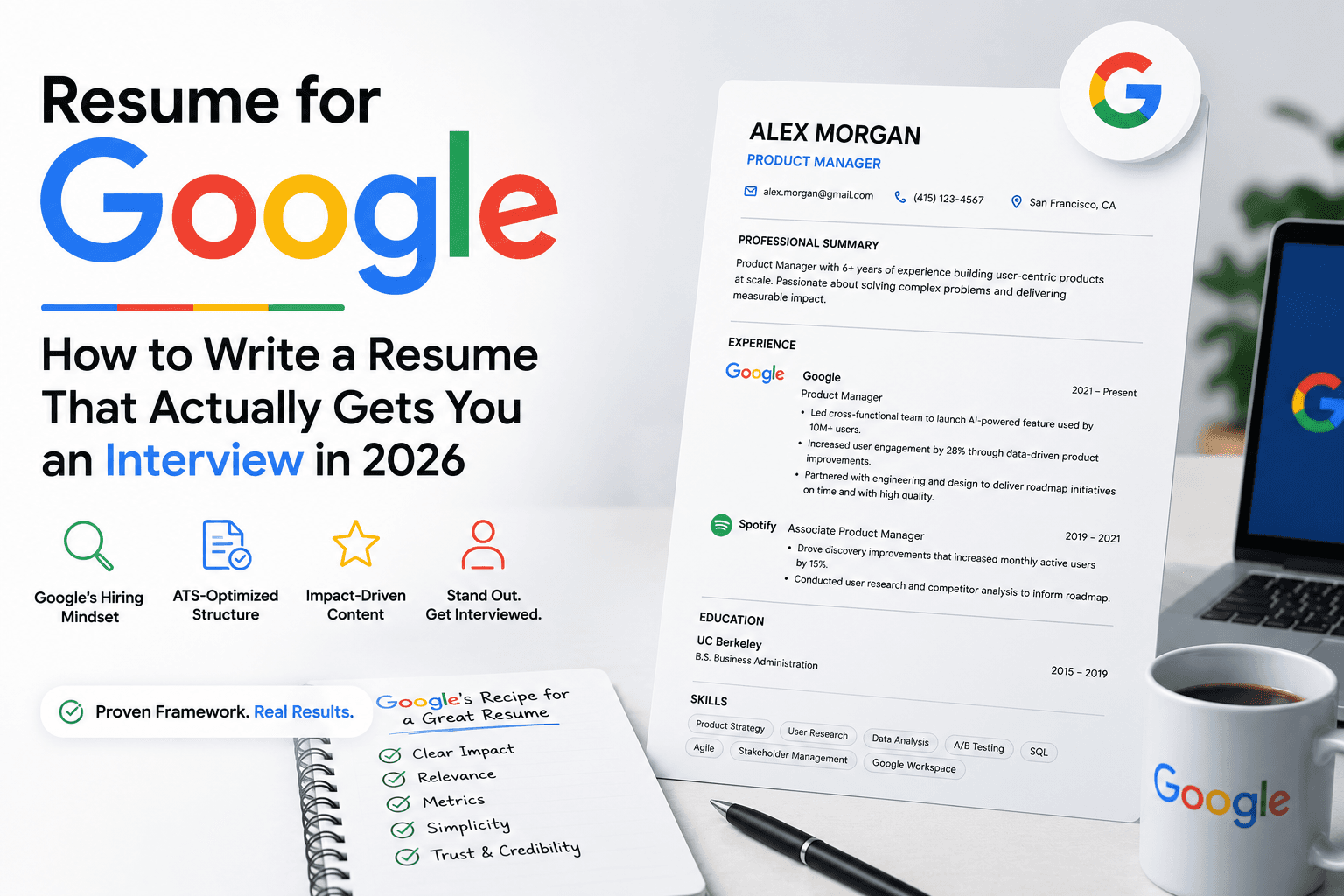
Google receives approximately 3 million applications per year. It hires roughly 20,000 to 30,000 people annually — an acceptance rate of less than 1%. For context, that makes getting a job at Google statistically harder than getting into Harvard.
But here's the part that matters for your resume: the filtering happens in stages, and most candidates are eliminated at stage one — before any human reads their application. Understanding how Google screens resumes isn't just useful. It's the difference between getting a recruiter call and getting an automated rejection.
This guide covers everything: how Google's hiring process works, what their ATS looks for, what their recruiters look for, what their hiring committees look for, and the specific resume format that passes all three filters. Plus the exact Google-specific keywords that show up most frequently in their job descriptions across roles.
How Google's Hiring Process Actually Works
Before optimizing your resume, you need to understand what it has to survive.
Stage 1 — ATS Screening: Google uses a proprietary applicant tracking system. Your resume is parsed for keyword alignment, formatting compatibility, and basic qualification matching. Candidates below a certain threshold are auto-filtered. This happens before any human sees your application.
Stage 2 — Recruiter Screen: A Google recruiter spends 30-60 seconds on your resume. They're looking for two things: evidence of impact at scale, and a clear signal that you meet the minimum qualifications for the role. They're not reading every bullet — they're pattern-matching.
Stage 3 — Hiring Committee: Unlike most companies, Google uses a hiring committee model. Multiple Googlers review your application packet (resume, references, interview feedback) before any offer is made. The committee isn't just checking qualifications — they're evaluating whether your experience fits Google's definition of excellence.
Google also uses a structured interviewing process focused on four core attributes: General Cognitive Ability (GCA), Leadership, Googleyness, and Role-Related Knowledge (RRK). Your resume is the first place these attributes should show up.
The Google Resume Format: One Non-Negotiable Rule
Google's careers page is explicit: they recommend a clean, single-column resume with no graphics, no photos, no colors, and no unusual fonts. This isn't aesthetic preference. It's ATS compatibility.
Google's system processes your resume as raw text. Multi-column layouts confuse the parser. Text boxes and graphics get skipped. A visually "impressive" resume with tables and icons often scores lower than a plain text document with strong content.
The format that works:
- Single column, top-to-bottom flow
- Standard fonts: Arial, Calibri, or Garamond at 10-12pt
- Standard section headers: Summary, Experience, Education, Skills (not "My Journey" or "What I Bring")
- Contact info in the body, not the header (many ATS systems skip header content)
- File format: PDF for most roles, unless the job description specifies otherwise
- Length: 1 page for under 5 years experience, 2 pages maximum for anyone else. Google recruiters have been explicit about this — beyond 2 pages, they stop reading.
The Google Resume Formula: XYZ Bullets
Google's own careers page describes the bullet point format they want to see. It's called the XYZ formula, and it was developed internally at Google:
"Accomplished [X] as measured by [Y] by doing [Z]."
This is not a suggestion. Google's recruiters are trained to look for this structure. A bullet that doesn't have a measurable outcome is, in Google's framework, incomplete information.
Before (what most candidates write):
Managed a team of engineers to build new product features
After (Google's XYZ format):
Led a team of 8 engineers to deliver 3 major product features in Q2, increasing user retention by 14% and contributing to a $2.1M uplift in annualized subscription revenue
The formula: what you did + how you measured it + how you did it. Every bullet. Not some bullets — every bullet in your experience section.
If you don't have exact numbers, use honest estimates: "approximately," "over," "up to." An estimated number is more useful than no number. Just don't fabricate metrics that don't reflect reality — Google's interview process is designed to probe the specific claims on your resume, and inflated numbers unravel quickly under questioning.
The 4 Attributes Google Actually Evaluates (And How to Show Them)
Google's hiring framework evaluates four attributes across every candidate. Your resume needs to surface evidence of all four.
1. General Cognitive Ability (GCA)
This isn't about your GPA. It's about demonstrated problem-solving — evidence that you can work through ambiguous, complex problems and arrive at effective solutions. Show this through:
- Bullets that describe a problem you diagnosed and solved, not just a task you completed
- Examples where you connected data or research to a decision that produced a measurable outcome
- Situations where you navigated ambiguity (a role that didn't previously exist, a market that hadn't been mapped, a system that had to be built from scratch)
2. Leadership
Google defines leadership broadly — it's not about managing people. It's about influence. A junior engineer who drove a process change that improved their team's velocity demonstrated leadership. Show this through:
- Any bullet where you drove a change that others adopted
- Initiatives you proposed, not just executed
- Cross-functional coordination where you aligned people without formal authority
3. Googleyness
This is the culture fit component — intellectual curiosity, collaborative orientation, comfort with ambiguity, and a bias toward action. You can't manufacture this in a resume, but you can signal it through:
- Side projects, open-source contributions, or learning initiatives
- Roles where you worked outside your formal scope because you saw a problem worth solving
- Career moves that reflect curiosity and growth over stability and comfort
4. Role-Related Knowledge (RRK)
The specific technical and domain skills for the role. This is where keyword matching lives. Every role at Google has a specific keyword set — the tools, methodologies, frameworks, and domain expertise that the job requires. Your resume must contain these exact terms, not paraphrases.
Google-Specific Keywords by Role Category
These are the keywords that appear most frequently in Google job descriptions across major role categories. Your resume should include the relevant ones using exact phrasing.
Software Engineering
distributed systems, large-scale infrastructure, system design, API development, Python / Go / Java / C++, Kubernetes, BigQuery, Spanner, reliability engineering, TDD, code reviews, technical debt reduction, latency optimization, microservices
Product Management
go-to-market strategy, OKRs, product-led growth, cross-functional alignment, user research, data-driven decision making, A/B testing, roadmap prioritization, stakeholder management, launch planning, PRD, north star metric
Data Science / Analytics
BigQuery, SQL, Python, statistical modeling, A/B testing, experimentation framework, Looker, data pipeline, machine learning, feature engineering, regression analysis, business intelligence
Marketing
performance marketing, growth marketing, demand generation, Google Ads, attribution modeling, conversion rate optimization, customer acquisition, LTV / CAC, content strategy, SEO, paid media, campaign analytics
Sales / Account Management
enterprise sales, quota attainment, pipeline management, SaaS sales, solution selling, Salesforce, customer success, expansion revenue, executive-level relationships, territory management
The Google Resume: Section by Section
Professional Summary (Optional but Recommended)
Google recruiters spend 30-60 seconds on your resume. A strong 3-line summary at the top gives them the context to read the rest more generously. Lead with your years of experience, your most impressive quantified result, and the specific role type you're targeting.
Software engineer with 7 years building distributed systems at scale — most recently led the migration of a 4M-user platform to microservices architecture, reducing p99 latency by 62%. Looking for senior engineering roles focused on infrastructure and reliability.
That summary tells a recruiter everything relevant in 3 seconds. Most candidates waste the summary with generic language like "results-driven professional seeking new opportunities." Never do that.
Experience Section
This is the core of your Google resume. Apply the XYZ formula to every bullet. Lead with your most impactful bullets in each role — don't bury your best results at the bottom of a list.
Ordering within each role: Most relevant/impactful achievement first. Chronological order of the bullets themselves is not the right approach — impact order is.
Tense: Current role in present tense. All previous roles in past tense. Consistency matters because Google's ATS parses tense as a signal of timeline.
Education
Google values educational background but doesn't gatekeep on it for most roles. For new graduates, put education near the top. For experienced candidates, it belongs at the bottom after your experience section. Include GPA only if it's above 3.5 and you graduated in the last 5 years.
Skills Section
Keep this lean and specific. A skills section with 40 tools listed is as useful as one with none — the signal-to-noise ratio destroys any value. List the 8-12 most relevant hard skills for the specific role. Use the exact terminology from the job description.
The Biggest Mistakes That Get Google Applications Rejected
Mistake 1 — Applying without tailoring. Google's ATS is sophisticated. A generic resume sent to 5 different Google roles will score differently on each one. You need a tailored version for each application.
Mistake 2 — Duties instead of achievements. "Responsible for managing cloud infrastructure" tells Google nothing. "Reduced infrastructure costs by $340K annually by migrating from on-premises servers to GCP Compute Engine" tells them something they can evaluate.
Mistake 3 — One-size-fits-all summaries. Your professional summary should mention the specific role type you're targeting. A summary for a Google PM role and a Google engineering role should look completely different, even if you're applying to both.
Mistake 4 — Applying too broadly at once. Google's ATS tracks applications. Applying to 12 different roles simultaneously signals that you don't know what you want and reduces your chances across all of them. Apply to 2-3 roles at a time, targeted by your actual experience.
Mistake 5 — Applying without an internal referral. Google's own data shows that referred candidates are significantly more likely to receive interviews. Before applying through the portal, check LinkedIn for first-degree connections at Google in your target department. A referral doesn't guarantee a job, but it meaningfully increases the probability that a human reviews your application.
How to Tailor Your Resume for Google in 8 Minutes
You now have the framework. Here's how to apply it efficiently:
- Open the specific Google job description you're targeting
- Run your resume through FutuRole's ATS Scanner against that job description — see your match score immediately
- Note the keywords in the red/missing category
- Use FutuRole's AI Resume Engine to tailor your resume to the posting — it mirrors Google's XYZ-adjacent output structure and optimizes keyword placement automatically
- Review the tailored output: make sure every bullet that was rewritten still accurately reflects your real experience. Google's interview process will probe these specifics directly.
- Export as PDF, apply, and use FutuRole's Contact Intelligence to find the Google recruiter or hiring manager for that team and send a personalized LinkedIn message the same day
The tailoring step that used to take 30-40 minutes takes 8-12 with this workflow. And for Google specifically, the difference between a tailored resume at 80%+ match score and a generic one at 45% is the difference between a recruiter screen and an automated rejection.
URL: futurole.com/blog/resume-for-google
Ready to tailor your resume for Google? Run your free ATS scan on FutuRole →