Job search · Career advice
Why Every Job Seeker Needs an Online Portfolio in 2026 (And How to Build One in 60 Seconds)
87% of companies now use AI in their hiring process. A resume alone isn't enough anymore. Here's why an online portfolio has become the most powerful — and most underused — tool in your job search, and how to create a professional one instantly.
Futurole Team
May 10, 2026 · 12 min read
Let's talk about what actually happens when a hiring manager receives your application in 2026.
First, an algorithm reads your resume. It scans for keyword matches, checks formatting compatibility, assigns a score. If you clear the threshold, you advance. If not, no human ever sees your name.
Then, if you do advance, a recruiter spends an average of 6 to 7 seconds scanning your resume before deciding whether to read further or move on. In those 6 seconds, your entire professional history is compressed into a pattern-recognition exercise.
And then — if you make it past both of those filters — something interesting happens. A Resume Builder survey from late 2025 found that 53% of hiring managers said they'd rejected candidates they suspected of using AI to write their entire application. Recruiters in 2026 are trained to spot generic, AI-generated content. They're skeptical. They want proof, not claims.
A PDF resume, however well-written, cannot provide that proof. An online portfolio can.
This article explains why an online portfolio has become the most powerful — and most underused — asset in a job search, what it should contain, and how FutuRole's AI Portfolio generator creates a professional, shareable portfolio from your resume in under 60 seconds.
The New Hiring Reality: AI Screens First, Humans Verify Second
87% of organizations now use AI at some point in the hiring process, and up to 93% of recruiters plan to increase their use of AI in 2026. This isn't a future trend. It's the present reality of every application you submit today.
AI use across HR tasks climbed to 43% in 2026, up from 26% in 2024 — a shift from pilots to real workflows. The machines are no longer being tested. They're running.
Here's what this means in practice: your resume now has to survive two audiences with completely different evaluation criteria before it generates an interview.
Audience 1 — The Algorithm: Keyword density. Formatting compatibility. Match score against the job description. The algorithm doesn't care about your leadership philosophy, your career story, or the three years you spent rebuilding a product from scratch. It cares whether your document contains the right words in the right sections.
Audience 2 — The Human: After the algorithm advances you, a real person finally looks at your file. But they're skeptical, they're time-pressed, and — in 2026 — they're increasingly aware that the document in front of them may have been generated or heavily edited by AI. The tells are obvious: generic phrasing, lack of specific detail, and a tone that reads like a Wikipedia entry.
The human wants evidence. They want to see the work, not just a description of it. They want to understand who you actually are beyond the formatted grid of dates and bullet points.
A resume can't show them that. A portfolio can.
What a Portfolio Does That a Resume Can't
A resume tells. A portfolio shows.
A resume tells people what you've done. A portfolio shows them. This applies far beyond creative fields. Data analysts can showcase dashboards. Marketers can share campaign results. Project managers can document case studies. Engineers can contribute to open-source projects.
The distinction matters more than it sounds. In a market where 70% of job seekers now use generative AI to research companies, draft cover letters, and prepare interview talking points, the surface-level outputs of a job search — resumes, cover letters, application forms — are becoming increasingly commoditized. Everyone has a polished resume. Everyone has a structured cover letter. The candidates who stand out are the ones who can point to something real.
Here's what a portfolio adds to your candidacy:
It creates a searchable, shareable web presence. A recruiter who receives your resume can Google you. If your portfolio shows up — with your work, your projects, your case studies, your professional summary — that recruiter spends significantly more time with your candidacy than someone whose Google results return nothing relevant. Developing and highlighting relevant AI skills may be the key to landing a job in 2026, particularly in occupations with otherwise muted hiring activity — and a portfolio is the fastest way to make those skills visible.
It demonstrates initiative before the interview. Sending a hiring manager a link to your portfolio alongside your application message signals something that no resume bullet point can: that you take your professional presence seriously enough to have built and maintained one. In a market where most candidates do the minimum, that signal is disproportionately valuable.
It provides context that resumes strip away. A resume says "led a product launch that drove $2.1M in pipeline." A portfolio entry can explain the actual problem, the constraints, the decisions made along the way, and the measurable outcome — with screenshots, data, or a brief case study. That depth is what converts a hiring manager's interest into a genuine desire to speak with you.
It works while you sleep. Your resume exists only when you send it. Your portfolio exists continuously, indexed by search engines, visible to recruiters doing passive sourcing, discoverable by people in your network who share your link. Companies using AI-assisted recruiter messaging are 9% more likely to make a quality hire — because better information produces better decisions. A portfolio gives recruiters better information.
Who Needs a Portfolio? (Spoiler: Everyone)
The most common objection: "I'm not in a creative field. Portfolios are for designers and writers."
This was accurate in 2019. It is no longer accurate in 2026.
Here's what a professional portfolio looks like across different roles:
Data analysts and scientists: Interactive dashboards, visualization samples, methodology write-ups, case studies of analytical problems you've solved. A data analyst who can link to a Tableau dashboard or a Python project is significantly more compelling than one whose resume says "proficient in Tableau and Python."
Marketers: Campaign results with real metrics, content samples, growth charts, brand work, launch case studies. A marketer who can show a 41% organic traffic increase with supporting context is more credible than one who lists it in a bullet point.
Product managers: Product thinking write-ups, roadmap rationale, feature retrospectives, user research frameworks. PMs who can articulate their decision-making process in writing demonstrate the judgment that a resume format can't capture.
Engineers: GitHub repositories, deployed projects, technical blog posts, open-source contributions. An engineer with a visible GitHub history that shows real, consistent work has a proof of skills that no resume can replicate.
Finance and operations professionals: Process improvement case studies, before/after documentation of systems you redesigned, anonymized examples of frameworks you built.
Consultants and project managers: Client outcomes (anonymized), project retrospectives, methodology documentation, structured problem-solving examples.
Only 6% of hiring managers report that their organizations have the talent needed to complete high-priority projects this year — which means the market is actively hungry for candidates who can demonstrate real capability, not just describe it. A portfolio is how you demonstrate it.
The Portfolio Gap: Why Most Candidates Still Don't Have One
If portfolios are this valuable, why don't more job seekers have them?
Three reasons, all of them solvable:
Reason 1: "It takes too long to build." Building a portfolio from scratch — choosing a platform, designing a layout, writing case studies, optimizing for SEO, making it mobile-responsive — used to take 10 to 20 hours. For someone in the middle of a job search already working 30+ hours per week on applications, interviews, and networking, that's an investment most people can't justify.
Reason 2: "I don't know what to include." Most professionals have done work worth showcasing. They just haven't organized it in a way that translates to a portfolio format. The mental overhead of deciding what's worth including, how to describe it without violating confidentiality, and how to structure it compellingly stops many people before they start.
Reason 3: "I don't have a technical background." The traditional portfolio building process involves choosing a hosting platform (Squarespace, Notion, GitHub Pages), customizing a template, writing the content, and publishing it. For non-technical candidates, that process alone is a meaningful barrier.
All three of these obstacles are what FutuRole's AI Portfolio feature was built to remove.
FutuRole's AI Portfolio: From Resume to Published Portfolio in 60 Seconds
Here's what the process looks like in practice.
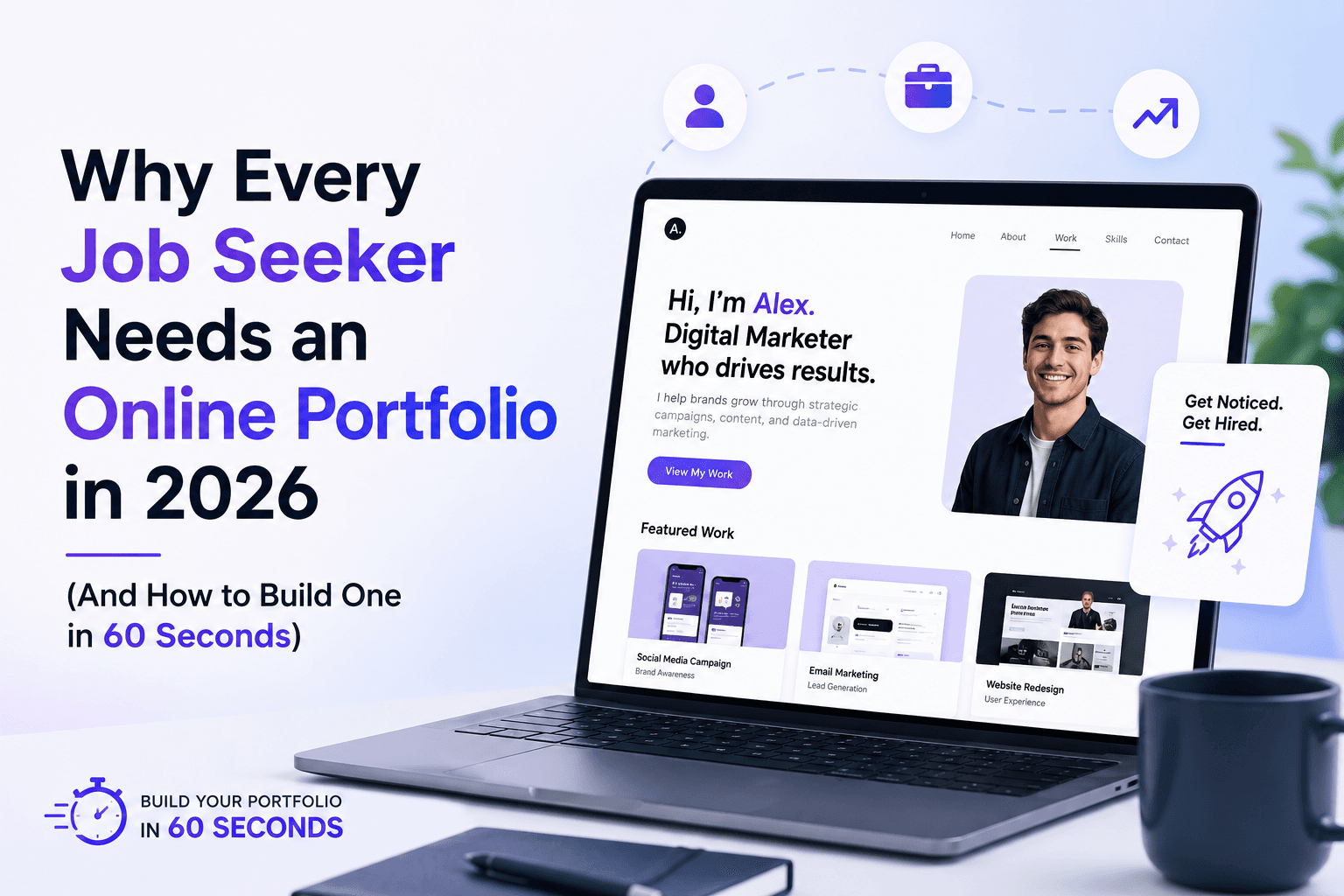
You upload your resume to FutuRole — the same resume you've already built and tailored for your job search. FutuRole's AI Portfolio generator reads your experience, projects, skills, and achievements, and builds a complete, professionally designed portfolio website from that content automatically.
The result is a shareable link — futurole.com/portfolio/yourname — that you can include in your resume header, your LinkedIn profile, your recruiter outreach messages, and your email signature. No coding. No design decisions. No writing from scratch.

The portfolio includes:
- A professional hero section with your name, title, and a one-paragraph summary generated from your resume's professional summary — editable to match your voice
- An experience timeline that presents your career history in a visual, scannable format with your achievement-based bullet points pulled directly from your resume
- A skills section that surfaces your technical and domain competencies clearly, without the compressed format of a resume's skills line
- A projects or highlights section where you can add work samples, case studies, links to external work, or brief write-ups — the content that a resume can't contain
- A contact section with direct links to your LinkedIn, email, and any other professional profiles you want to surface
The design is clean, professional, and mobile-responsive — meaning it renders correctly whether a recruiter opens it on a desktop browser or their phone between meetings. Six visual themes are available, ranging from minimal and corporate to slightly warmer and more personal, so you can match the aesthetic to your industry.

The shareable link works immediately. You don't wait for deployment, DNS propagation, or hosting setup. You generate the portfolio, customize anything that needs adjusting, and the link is live.
How to Use Your Portfolio at Every Stage of the Job Search
The portfolio is most powerful when it's integrated into your search systematically — not just added to your resume header and forgotten.
In your resume header: Add the portfolio link alongside your LinkedIn URL and email address. For a hiring manager who advances past the ATS screen and opens your resume, a portfolio link is an invitation to spend more time with your candidacy. Most hiring managers will click it.
In direct outreach messages: When you reach out to a hiring manager or recruiter directly — which FutuRole's Contact Intelligence makes a two-minute task — a portfolio link embedded in the message gives them a reason to engage with you beyond the conversation. "You can see some of my recent work at [link]" converts a cold message into a warm interaction.
In your LinkedIn profile: LinkedIn's "Featured" section allows you to pin a portfolio link at the top of your profile. Recruiters who land on your LinkedIn via search will see your portfolio immediately — before they read a single line of your experience section.
In interview follow-ups: After a first-round interview, a thank-you email that includes a portfolio link — especially a specific project or case study directly relevant to something discussed in the interview — keeps your candidacy active between rounds and gives the hiring team something concrete to share internally.
For passive sourcing: By 2028, some predict that one in four candidate profiles worldwide will be fake, which is driving stricter verification requirements — meaning hiring managers are increasingly valuing verifiable, public professional presence. A portfolio that's been live for weeks or months, with consistent content and a shareable URL, signals a level of professional seriousness that a freshly submitted resume can't match.
The Candidates Who Will Win in the AI Era
Indeed's Hiring Lab found that developing and highlighting relevant skills may be the key to landing a job in 2026, particularly in occupations with otherwise muted hiring activity. The candidates who will win in this market are the ones who understand that the hiring funnel now has two distinct phases — the algorithmic phase and the human phase — and who optimize for both.
A tailored resume with a high ATS match score gets you past the algorithm. A portfolio that shows real work, real results, and real professional depth gets you past the human. Both are necessary. Neither alone is sufficient.
The barrier to having a portfolio in 2026 is sixty seconds and a resume you already have.
FutuRole generates your portfolio from that resume automatically. You pick a theme, review the output, add any additional work samples or project details you want, and publish. The link is live immediately.
The candidates across from you in the interview process are applying with the same keywords, the same resume formats, and increasingly, the same AI-assisted content. A portfolio is the proof layer that separates a claim from evidence — and in a market where everyone is making the same claims, evidence wins.
URL: futurole.com/blog/online-portfolio-job-search-2026
Generate your professional portfolio in 60 seconds — from the resume you already have. Try FutuRole free →