Resume · Job search
Resume for Meta: How to Write a Resume That Gets You a Meta Interview in 2026
Meta's hiring process is one of the most rigorous in tech — and one of the most misunderstood. Here's the exact resume structure, Meta-specific keywords, and impact evidence that gets candidates past screening and into the loop.
BlogWriter Team
May 10, 2026 · 10 min read
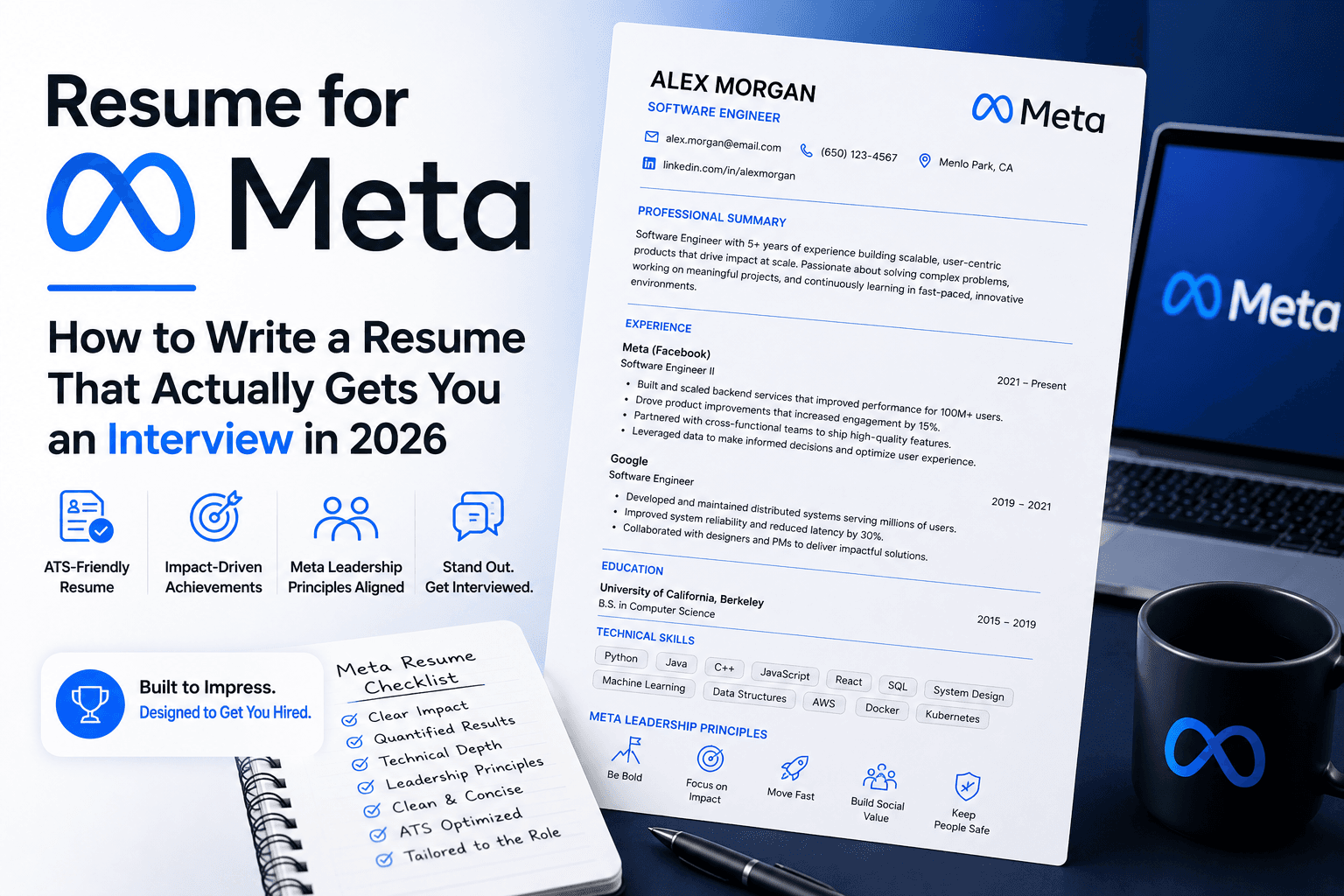
Meta — the parent company of Facebook, Instagram, WhatsApp, and Reality Labs — is one of the ten most searched companies by job seekers in the US. It's also one of the most competitive employers in tech: Meta consistently receives millions of applications annually and has one of the most rigorous technical screening processes of any major company.
After several high-profile rounds of layoffs in 2022-2023, Meta entered 2024 and 2025 as a leaner, more selective operation. The "Year of Efficiency" transformed how Meta hires: the company now moves faster, demands more demonstrated impact per headcount, and holds a higher bar on technical and execution skills than it did before the restructuring.
Understanding what Meta looks for in 2026 — and how to show it on your resume — is different from understanding what Meta looked for in 2021. This guide reflects the current reality.
How Meta's Hiring Process Works in 2026
Stage 1 — ATS Screening: Meta uses a proprietary ATS for initial screening. The system evaluates keyword alignment, experience level, and minimum qualification matching. Formatting issues (tables, multiple columns, text boxes) reduce parsing accuracy.
Stage 2 — Recruiter Screen (30-45 minutes): A Meta recruiter conducts a screen focused on basic qualifications and — for technical roles — whether you can pass a coding screen. For non-technical roles, this screen evaluates communication clarity, impact evidence, and cultural fit signals.
Stage 3 — Technical or Domain Screen (45-60 minutes): For engineering roles, this is a coding interview focused on data structures and algorithms (DSA) — Meta's screens are known to be among the most technically demanding in the industry. For product, marketing, and operations roles, this stage varies by team.
Stage 4 — The Onsite Loop (4-5 interviews): Meta's loop includes role-specific technical interviews, behavioral interviews (called "Jedi" interviews at Meta — named after the concept of "Behavioral Execution"), and for senior roles, a system design interview. The Jedi component evaluates Meta's core values: Move Fast, Focus on Long-Term Impact, Build Awesome Things, Live in the Future, and Be Direct.
Stage 5 — Hiring Committee and Offer: Senior roles go through a hiring committee review. Junior and mid-level roles may be decided by the hiring manager with recruiter input.
Meta's Core Values: What They Mean for Your Resume
Meta's culture, post-restructuring, is built on five values that shape how they hire. Your resume needs to demonstrate these values through evidence, not language.
Move Fast. Meta is famous for this value — "Move fast and break things" was the original motto before "Move fast with stable infrastructure." The current version means: execute quickly, don't wait for perfect information, make decisions with the data you have. Show this through bullets that demonstrate rapid execution, fast iteration cycles, and decisions made under uncertainty that produced real outcomes.
Focus on Long-Term Impact. Meta thinks in decades about platform and product, and in quarters about execution. They want people who can hold both timelines simultaneously — executing with urgency while making decisions that compound positively over time. Show this through bullets that describe both the immediate result and the systemic change it created.
Build Awesome Things. This is Meta's craft signal — they want people who care about the quality of what they build, not just the output. Show this through specific descriptions of the work itself: what made it technically interesting, what tradeoffs were navigated, why the solution was better than the obvious one.
Live in the Future. Meta is building toward AR/VR/AI as the next computing platform. Candidates with demonstrated experience or interest in AI, spatial computing, or emerging technology signal alignment with this value. If you have any, make it visible.
Be Direct. Meta values clear, direct communication over diplomatic hedging. Your resume bullet points should be direct and specific. "Improved key metrics" is not direct. "Increased Instagram Reels watch time by 8% in Q3 by redesigning the recommendation algorithm's cold-start model" is direct.
The Meta Resume Format
Meta's ATS has similar technical requirements to Amazon and Microsoft:
- Single column — multi-column layouts reduce parsing accuracy
- No graphics, photos, or images
- Standard fonts — Arial, Calibri, or Helvetica at 10-12pt
- Contact in the body — not in headers or footers
- PDF format
- Length: 1 page for under 5 years experience, 2 pages maximum for senior roles
One Meta-specific note: Meta's engineering culture values concision. A resume that gets to the point faster — fewer words per bullet, higher information density — aligns with the directness Meta values. If you can say the same thing in 15 words instead of 25, say it in 15.
The Meta Bullet Formula: Impact First, Always
Meta's hiring managers evaluate resumes for one thing above all others: demonstrated impact at scale. Not effort, not responsibility, not team size — impact. What changed in the world because you were there?
The Meta bullet formula:
[Strong action verb] + [what you did at scale] + [business impact with metric] + [optional: the mechanism or approach]
Note that Meta's formula inverts Google's XYZ slightly — the impact number comes earlier, before the mechanism. This is because Meta's culture is impact-first: they want to know the result before they care about how you achieved it.
Examples by role:
Software Engineering: Before: "Worked on improving the News Feed ranking algorithm" After: "Redesigned News Feed ranking model's feature selection pipeline, increasing meaningful social interactions by 3.2% across 2B+ daily active users — equivalent to approximately 64M additional meaningful interactions per day"
Product Management: Before: "Managed the Instagram Stories product" After: "Shipped 4 Stories features in H2 2025 driving a 12% increase in daily story creators — grew the creator base by 8M in 90 days while maintaining content quality NPS above 4.2/5"
Data Science: Before: "Built models to improve ad targeting" After: "Built a new advertiser audience model reducing cost-per-click by 18% across Meta's small business advertising segment — translating to approximately $240M in efficiency gains annualized across the portfolio"
Marketing: Before: "Ran campaigns for Meta's Business Suite product" After: "Launched a 6-market integrated campaign for Meta Business Suite that drove 2.4M SMB sign-ups in Q1 2026 — 31% above target — with a CAC 22% below the previous campaign benchmark"
Operations: Before: "Managed content moderation operations" After: "Redesigned the escalation workflow for content moderation across 3 regional teams, reducing average decision time from 4.2 hours to 47 minutes while improving inter-rater reliability from 71% to 88%"
Meta-Specific Keywords by Role Category
Software Engineering
Python / C++ / Hack / JavaScript, React / React Native, GraphQL, distributed systems, ranking systems, recommendation systems, machine learning, PyTorch, Spark, Presto, data structures and algorithms, system design, A/B testing infrastructure, production oncall, low-latency, high-throughput
Product Management
product strategy, north star metric, DAU / MAU, engagement metrics, A/B testing, user research, data-driven, roadmap, social graph, content ecosystem, creator economy, monetization, ads integration, go-to-market, platform thinking
Data Science / Analytics
Python, SQL, PyTorch, statistical modeling, experimentation, A/B testing, causal inference, feature engineering, Hive, Presto, Spark, user behavior analysis, ad auction, feed ranking, growth modeling
Marketing
growth marketing, performance marketing, Meta Ads, demand generation, brand marketing, creative strategy, attribution modeling, LTV / CAC, app install campaigns, creative testing, audience segmentation, conversion optimization
People / HR
talent acquisition, people analytics, organizational design, performance management, DEI strategy, employee experience, compensation design, workforce planning, HRBP, change management
Sales / Advertising (Global Business Group)
Meta advertising, media planning, auction dynamics, performance marketing, agency relationships, brand safety, SMB / enterprise sales, campaign optimization, attribution, CPM / CPC / ROAS, vertical expertise
What Meta Looks For That Most Candidates Miss
Scale fluency. Meta operates at 2B+ daily active users. They hire people who are comfortable reasoning about, designing for, and communicating in terms of 9-figure user bases. Candidates who only discuss outcomes in thousands or tens of thousands of users don't signal Meta-readiness. If your experience has involved meaningful scale, quantify it in scale terms: users served, transactions processed, market reach.
Experimentation culture. Meta runs thousands of A/B tests simultaneously. They expect everyone — not just data scientists — to understand experimentation, statistical significance, and how to interpret test results. Any experience with A/B testing, hypothesis-driven development, or data-informed decision-making should be explicit on your resume.
AI and ML familiarity. Meta's products are deeply ML-powered: the Feed, Reels recommendations, ad targeting, content moderation. Candidates with any ML familiarity — even non-technical exposure like using ML-driven tools, participating in ML feature launches, or working with ML teams — are stronger candidates. Make this visible if you have it.
"Move Fast" evidence. The post-efficiency Meta moves significantly faster than the pre-2023 version. Candidates who can show fast execution cycles — features shipped in weeks not quarters, rapid iterations based on early data, decisions made without full information — align better with the current culture than candidates whose bullets all describe 18-month strategic initiatives.
The Most Common Reasons Meta Rejects Resumes
No scale. Meta operates at a scale most companies don't. If your experience has been at small-to-mid-size companies, you need to demonstrate that you understand how to translate your skills to Meta's scale — not just that you're technically competent at your current scope.
Too safe. Meta's culture rewards boldness and directness. Resumes that describe cautious, consensus-driven approaches to everything signal cultural misalignment. Include examples where you made a call under uncertainty, moved fast before having complete information, or advocated strongly for something others pushed back on.
Weak technical signal for engineering roles. Meta's technical bar is among the highest in the industry, particularly for DSA. Your resume is not where the technical screen happens, but it needs to signal technical depth — through the specificity of the systems you've described, the scale at which you've operated, and the technical choices you've explicitly mentioned.
Generic bullets for platform roles. Product, marketing, and operations candidates at Meta need to demonstrate familiarity with Meta's specific product ecosystem (Facebook, Instagram, WhatsApp, Reels, Marketplace, Meta AI). A generic PM resume with no signal that you understand social product dynamics, creator economies, or advertising systems is a weak fit signal for most Meta teams.
Tailoring Your Resume for Meta in 10 Minutes
Meta's ATS and hiring managers both reward specificity and scale. A generic resume sent to Meta will be auto-filtered or rejected at the recruiter screen in the first 30 seconds.
FutuRole's AI Resume Engine tailors your resume to any Meta job posting in 60 seconds: it mirrors the JD's exact language, adjusts your bullets to lead with the most relevant impact evidence for that specific team, and outputs an ATS-ready PDF. The ATS Scanner shows you exactly which keywords are missing before you submit — so you don't send a 44% match score application to one of the most competitive hiring pipelines in tech.
After applying, use FutuRole's Contact Intelligence to find the recruiter or hiring manager for the specific Meta team and send a direct LinkedIn message the same day. At Meta specifically, where internal mobility is strong and team culture varies significantly across Facebook, Instagram, WhatsApp, and Reality Labs, a message that demonstrates you've researched the specific team — not just "Meta" generally — converts significantly better than a generic outreach.
URL: futurole.com/blog/resume-for-meta
Tailor your resume for Meta's impact-first culture in 60 seconds. Run your free ATS scan on FutuRole →