Resume · Job search
How to Turn Resume Duties Into Achievements (With 40+ Real Examples by Industry)
Still listing job duties on your resume? That's why you're not getting interviews. Learn exactly how to rewrite every bullet point as a quantified achievement — with real before/after examples for every industry.
Futurole Team
April 27, 2026 · 13 min read
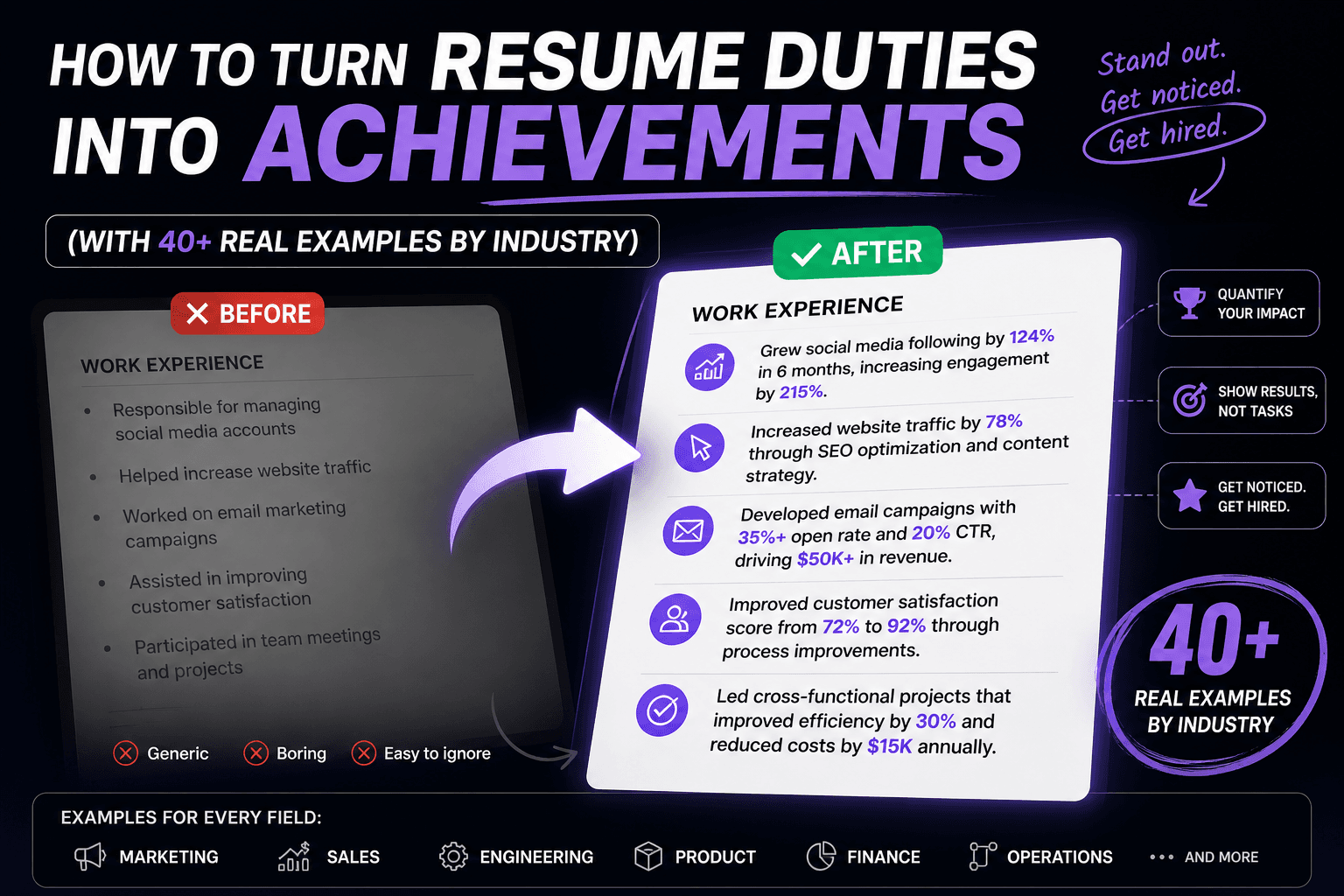
There is one mistake that appears on almost every resume that gets ignored.
It isn't a formatting error. It isn't missing keywords. It's something more fundamental — and it's the reason why hiring managers spend 6 seconds on your resume and move on.
The mistake is listing what you were responsible for instead of what you actually accomplished.
"Responsible for managing client relationships." "Handled social media accounts." "Assisted with product development."
These are duties. Every single person who held the same job title has the same duties. They tell a hiring manager nothing about whether you were good at the job, bad at the job, or anywhere in between. They are invisible.
According to The Interview Guys' 2026 resume analysis, "achievement-focused bullet points dramatically outperform basic responsibility statements" in the 6-second window a recruiter spends scanning a resume. And iCareerSolutions cites research showing that "quantitative metrics can give job seekers a 40% advantage over their competition."
The fix is learnable. This guide walks you through every step — the formula, the method for finding your numbers, and 40+ before/after examples across 10 industries you can model directly.
Why Achievements Beat Duties Every Time
Think about it from the hiring manager's perspective. They're reviewing 50 resumes for a single role. Most of those resumes describe the same job in the same language. "Managed a team." "Oversaw projects." "Coordinated with stakeholders."
After the tenth resume with identical phrasing, none of it registers.
Then they see: "Rebuilt the onboarding flow for 3,200 enterprise users, reducing time-to-activation from 14 days to 4 and cutting churn by 22% in Q3."
That stops the scan. It raises a question: how did they do that? And questions lead to interview invitations.
Teal's resume research frames it precisely: "It's easy to claim you've 'improved a process' or 'led a team,' but quantifiable bullet points show you've taken the time to reflect on your work and can articulate your value in concrete terms." Quantified achievements provide proof. Duties provide claims.
Beyond human readers, Indeed's career research notes that specific numbers "separate your resume from comparable applicants" in multiple rounds of assessment — including ATS scoring, which increasingly uses natural language processing to evaluate the substance of your experience, not just keyword presence.
The Formula: One Structure That Works for Every Role
You don't need to memorize multiple frameworks. Resume.io's bullet point research identifies one clear structure that consistently performs:
Action verb + task or context + measurable result
That's it. Every strong bullet point follows this pattern. Here's what each element means:
Action verb: A strong, specific verb that shows what you did. Not "helped" or "worked on" or "was responsible for." Verbs like: built, grew, reduced, launched, redesigned, negotiated, trained, increased, eliminated, secured.
Task or context: What you did it on, for whom, and under what circumstances. This is where you add enough detail to make the achievement understandable without a decoder ring.
Measurable result: The number that proves it worked. A percentage, a dollar amount, a time saved, a volume handled, a ranking earned. If you don't have an exact number, an estimate that reflects honest scale still works — "approximately," "over," "up to."
Assembled:
Renegotiated SaaS vendor contracts across 12 tools, reducing annual software spend by $340,000 (28%) without losing a single key integration.
That bullet answers four questions in one sentence: what did you do, how did you do it, what was the scale, and what was the outcome. A hiring manager reading it understands your value immediately.
How to Find Your Numbers (Even When You Think You Don't Have Any)
The most common objection: "My job isn't quantifiable. I don't have metrics."
Almost every job has metrics. You just haven't been tracking them. Here's how to excavate them:
Pull from memory and estimation. Resume Genius's quantification guide confirms: "If you don't have specific numbers from previous jobs, you can use estimates to convey the impact of your work." Ask yourself: How many? How often? How much? How long? How many people? Even rough estimates — "reduced processing time by approximately 40%" — are more compelling than no number at all.
Search your email archive. Dig through old performance reviews, project summaries, client feedback emails, and all-hands reports. Numbers that felt routine at the time ("hit 94% of quarterly targets") become powerful resume bullets in retrospect.
Check public data. Resume Genius suggests using public sources: app store ratings, social media follower counts you managed, website traffic (SimilarWeb), company revenue data from Crunchbase or press releases. If you contributed to growth that's documented anywhere publicly, that data is yours to use.
Use scale and volume when percentages aren't available. "Managed a portfolio of 22 enterprise clients" is quantified. "Processed 150+ support tickets per week while maintaining a 4.8/5 CSAT score" is quantified. "Recruited and onboarded 8 junior developers in Q2" is quantified. Numbers don't always have to be percentages.
40+ Before/After Examples by Industry
Here is the section you can use directly. For each role, take the "before" as a diagnosis — if your resume looks like this, it needs work — and model your rewrite on the "after."
Sales
Before: Responsible for managing client accounts and driving revenue growth. After: Managed 18 enterprise accounts generating $4.2M ARR, achieving 112% of quota for 3 consecutive quarters and earning President's Club recognition in 2025.
Before: Cold called prospects and set up meetings. After: Generated 60+ qualified pipeline meetings per month through cold outreach, contributing $1.8M in new business opportunities to the Q4 pipeline.
Before: Helped with client retention efforts. After: Rebuilt the renewal process for at-risk accounts representing $3.1M in ARR, achieving a 96% retention rate in a quarter where industry average fell to 81%.
Marketing
Before: Managed social media accounts for the company. After: Grew LinkedIn following from 4,200 to 31,000 in 9 months through a consistent content strategy, increasing inbound lead volume by 38%.
Before: Wrote blog posts and managed the content calendar. After: Published 16 SEO-optimized articles per month, driving organic traffic from 12,000 to 54,000 monthly sessions in 11 months and generating 320+ marketing-qualified leads.
Before: Ran paid advertising campaigns. After: Managed $180,000/month Google Ads budget across 6 campaigns, reducing cost-per-acquisition by 31% while maintaining lead volume — saving $55,000 in quarterly ad spend.
Before: Worked on email marketing. After: Redesigned the 6-email welcome sequence for 22,000 new subscribers, increasing click-through rate from 11% to 27% and reducing first-week churn by 18%.
Software Engineering
Before: Developed features for the company's web application. After: Built and shipped 4 core product features in 6 months, reducing average page load time by 62% and directly contributing to a 14-point NPS improvement cited in Q3 board reporting.
Before: Fixed bugs and resolved technical issues. After: Resolved 200+ production bugs over 12 months with an average time-to-resolution of 4.2 hours, reducing customer-reported incidents by 41% YoY.
Before: Helped with code reviews and documentation. After: Introduced a structured code review protocol across a 12-person engineering team, reducing post-deployment bugs by 33% and cutting rollback incidents from 9 to 2 per quarter.
Before: Worked on backend infrastructure. After: Migrated a monolithic architecture to microservices for a system processing 2M+ daily transactions, improving uptime from 97.1% to 99.8% and cutting deployment time from 4 hours to 22 minutes.
Product Management
Before: Managed the product roadmap and worked with engineering. After: Defined and executed a 12-month roadmap for a B2B SaaS product with 8,000 active users, shipping 3 major features that drove a 24% increase in DAU and reduced average session time-to-value by 40%.
Before: Gathered user feedback and conducted research. After: Ran 60+ user interviews and synthesized findings into a product brief that directly shaped the redesign of the core workflow, reducing task completion time by 35% in usability testing.
Before: Coordinated between design, engineering, and marketing. After: Launched a cross-functional product release involving 4 teams and 18 stakeholders, delivering on time and under budget — the first on-schedule major release in 3 years.
Operations & Project Management
Before: Managed projects and ensured deadlines were met. After: Led 7 concurrent projects across 3 business units with a combined budget of $2.4M, delivering 6 of 7 on time and under budget, achieving an 89% on-time delivery rate vs. a company average of 71%.
Before: Improved processes to increase efficiency. After: Redesigned the vendor invoice approval workflow, reducing processing time from 11 days to 2 and eliminating $23,000 in late payment penalties annually.
Before: Coordinated logistics and supply chain. After: Renegotiated 5 key supplier contracts during Q2, securing 14% average cost reduction and reducing lead times from 8 weeks to 5 across the top 3 SKUs.
Customer Success
Before: Managed customer relationships and handled support. After: Managed a portfolio of 45 mid-market accounts worth $2.8M in ARR, maintaining a 94% net retention rate and expanding 12 accounts through upsell — contributing $310,000 in expansion revenue.
Before: Onboarded new customers. After: Redesigned the onboarding program for 200+ new accounts per quarter, reducing time-to-first-value from 21 days to 8 and cutting 60-day churn from 18% to 7%.
Before: Resolved customer issues and escalations. After: Handled tier-2 escalations for enterprise accounts with SLAs under 4 hours, maintaining a 98.3% SLA compliance rate and a 4.9/5 CSAT score across 800+ tickets.
Finance & Accounting
Before: Prepared financial reports and managed budgets. After: Prepared monthly P&L, balance sheet, and cash flow statements for a $42M business unit, reducing close cycle from 8 days to 3 through process automation.
Before: Helped with cost reduction initiatives. After: Identified $1.2M in overhead savings across 6 departments through a zero-based budgeting initiative, presenting findings directly to the CFO and achieving board approval in one session.
Before: Managed accounts payable and receivable. After: Reduced DSO (days sales outstanding) from 48 to 31 days by overhauling the invoicing and collections process, improving cash flow by approximately $800,000 per quarter.
Human Resources
Before: Recruited candidates and managed the hiring process. After: Reduced average time-to-hire from 52 days to 28 across 40+ hires by restructuring the interview pipeline and introducing structured evaluation scorecards.
Before: Managed employee onboarding. After: Redesigned the 30-60-90 day onboarding program for a 600-person company, improving new hire 90-day retention from 74% to 91% and reducing ramp time by an average of 3 weeks.
Before: Handled employee relations and HR issues. After: Resolved 95% of employee relations cases within 10 business days while maintaining compliance with employment law across 4 jurisdictions, supporting a workforce of 1,200+.
Education & Training
Before: Taught classes and developed curriculum. After: Designed and delivered a 12-week data literacy curriculum for 180 undergraduates, achieving a 94% course completion rate and a 4.8/5 instructor rating — highest in the department.
Before: Helped students improve their academic performance. After: Provided targeted intervention for 22 at-risk students over one semester, with 18 achieving passing grades — an 82% success rate vs. a department average of 55%.
Healthcare & Nursing
Before: Provided patient care and managed treatment plans. After: Managed care for 8–12 patients per shift in a high-acuity ICU, maintaining full compliance with clinical protocols and contributing to a unit-level HCAHPS score of 91st percentile.
Before: Coordinated with the care team. After: Led weekly interdisciplinary care conferences for 14 complex patients, reducing average length of stay by 1.4 days and cutting readmission rates by 19% within 6 months.
When You Can't Quantify: What to Do Instead
Not every contribution produces a clean metric. Columbia Career Education's resume guide acknowledges this directly: "You don't need to add a result to every bullet point on your resume, but it's helpful to demonstrate achievements when possible."
When numbers aren't available, Resume Genius recommends using phrases that still convey scale and significance: "significantly improved," "consistently exceeded," "substantially reduced," and "selected as one of [X] from [Y] candidates." These signal impact without fabricating specifics.
You can also quantify by scope when outcome data doesn't exist: "Authored 14 internal SOPs adopted across 3 departments" is quantified by volume. "Represented the company at 6 industry conferences" is quantified by frequency. "Selected from a pool of 200 applicants" is quantified by selectivity. Any number that adds honest context is better than no number.
The Rewrite Process: How to Do This for Your Entire Resume
Set aside 90 minutes. Work through your experience section role by role.
Step 1: For each bullet, ask: Is this a duty or an achievement? If you could copy it directly from the job description, it's a duty. Rewrite it.
Step 2: For each duty-based bullet, ask the three questions from Yale's Office of Career Strategy: What was the result? Can I quantify it? What would the comparison baseline be (before vs. after)?
Step 3: Write the rewrite using the formula: Action verb + context + measurable result. Keep it to one to two lines. Cut anything that doesn't add information.
Step 4: Once your bullets are achievement-based, tailor them to the specific job you're applying for. Mediabistro's resume metrics guide recommends: "Tailoring your resume's metrics and achievements to align with the job you're applying for can further enhance your application." If the job emphasizes revenue growth, lead with revenue bullets. If it emphasizes efficiency, lead with operational improvements.
This is where most candidates stop — they rewrite their resume once and send it everywhere. The highest-response-rate approach is a strong achievement-based base resume, plus targeted tailoring for each role. FutuRole handles the tailoring step automatically: paste a job link and it adjusts your bullet points, keywords, and summary to match the posting — preserving your achievements while optimizing the framing for each specific opportunity.
The Difference This Makes
Here is what happens when you switch from duties to achievements:
Your resume survives the 6-second scan because something specific catches the eye. The hiring manager has a concrete mental picture of what you've accomplished — not a vague sense of what you were "responsible for." Your bullets answer the question every hiring manager is really asking: will this person produce results for us, or just occupy a seat?
The Interview Guys put it well: "Achievements don't always need to be about saving millions or increasing metrics by triple digits. Consistent improvements of 5–10% can be just as impressive, especially if sustained over time or achieved in challenging circumstances."
The bar isn't perfection. The bar is specificity. Specific always beats vague. A 7% improvement with a clear story beats a "significant improvement" every single time.
Rewrite three bullets today. Then three more. By the end of the week, you'll have a resume that tells the story of someone who produces results — because that's exactly what you do.
URL: futurole.com/blog/resume-achievements-vs-duties
Once your bullets are strong, make sure they're reaching the right people. FutuRole tailors your achievement-based resume to every job description automatically — so your best work is always in front of the right recruiter.