Job search · Resume · ATS
Sent 100 Applications, No Response? Here's Exactly Why (And How to Fix It)
Applying to dozens of jobs with no response? You're not alone — and it's not your fault. Here's the real reason your applications disappear, and what actually works in 2026.
Futurole Team
April 27, 2026 · 9 min read
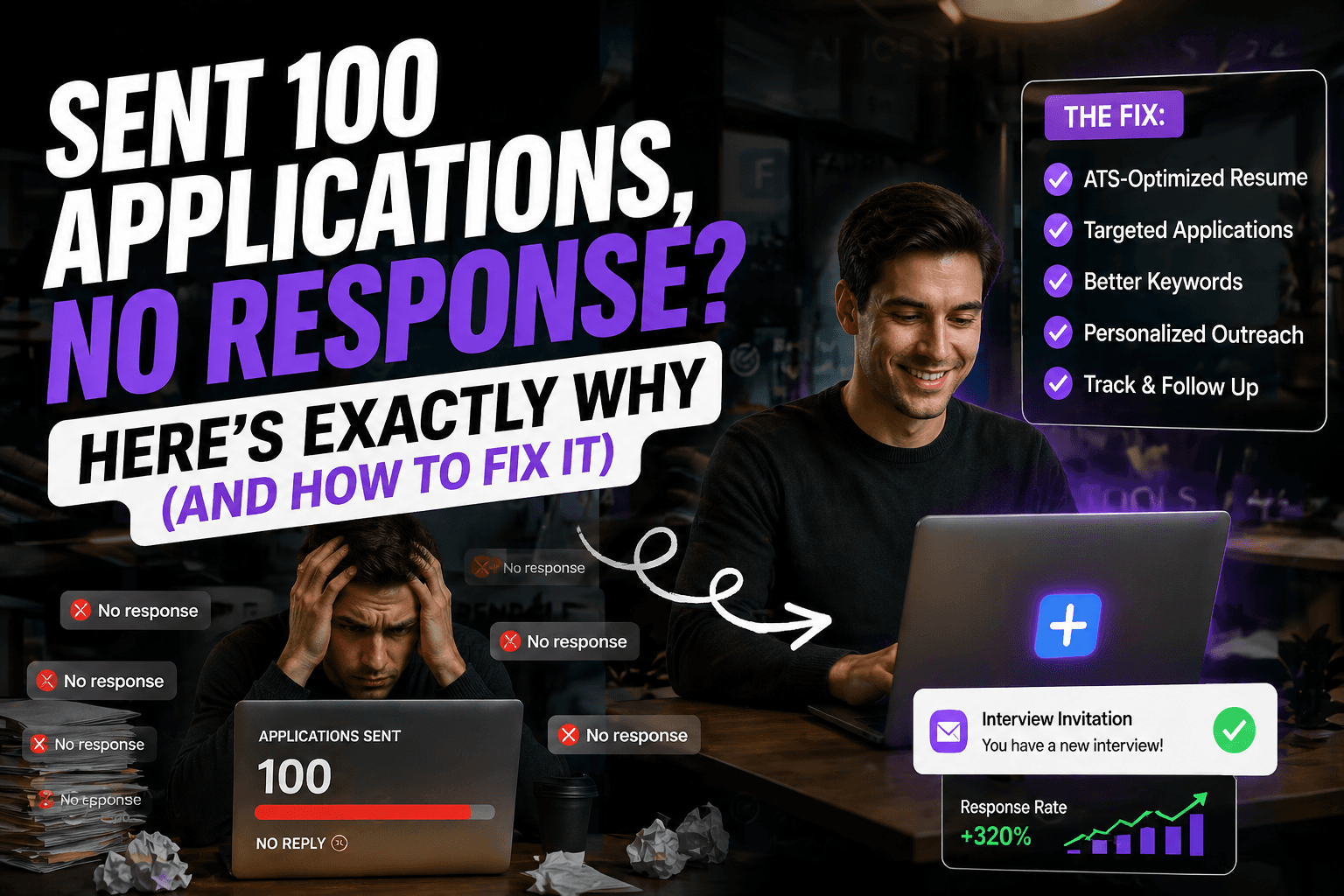
You've done everything right. You updated your resume. You wrote cover letters. You applied to dozens of roles — maybe hundreds. And you've heard almost nothing back.
No interview requests. No rejections. Just silence.
If this is your situation, you are not imagining it and you are not failing. According to research cited by The Interview Guys, 75% of job applications are rejected by automated systems before a human ever reads them. That means three out of every four applications you send disappear before a recruiter sees your name.
This isn't a numbers game. It's a system game. And the system is working against you in ways most job seekers never figure out.
This guide explains exactly what's happening — and what to do about it.
Why Your Applications Are Disappearing
The ATS Black Hole Is Real
Almost every company with more than 50 employees uses an Applicant Tracking System — software that scans, parses, and scores your resume before any human reviews it. According to Gainrep, ATS systems reject up to 75% of resumes because they aren't optimized for the role.
The system doesn't read your resume the way a person would. It extracts text, looks for keyword matches against the job description, checks formatting compatibility, and assigns you a score. If your score is below a threshold — which you never see — you're auto-rejected. The recruiter never knows you applied.
This is why InterviewPal's 2026 analysis describes the experience perfectly: "Your resume is not being beaten by the ATS. It is just never being found."
Ghost Jobs Are Inflating the Numbers
A significant portion of job postings don't represent real, open roles. Greenhouse's platform data shows that between 18 and 22% of all jobs posted in any given quarter are ghost jobs — listings with no real intention to hire. Companies post them to build candidate pipelines, to satisfy HR documentation requirements, or because the role was filled internally before the posting went live.
When roughly one in five listings isn't real, some of your silence isn't a reflection of your resume at all. It's a reflection of a broken posting system.
You're Competing Blindfolded
The Interview Guys describe the problem precisely: "You're customizing your resume, adding keywords, following all the advice. But you have no idea if it's working." The average job posting receives 250+ applications within the first 24 hours. Hiring managers have roughly 6 to 7 seconds to scan each resume that passes ATS filtering — which means they're not reading, they're pattern-matching.
If your resume doesn't signal the right patterns in the first glance, it moves to the bottom of the pile even after passing the automated screen.
The 6 Real Reasons You're Not Getting Responses
1. Your Resume Isn't Matching the Job Description's Language
ATS systems don't evaluate your experience — they compare your words to their words. If a job description says "cross-functional stakeholder management" and your resume says "worked with multiple teams," the system may not match them, even though they mean the same thing.
Huntr's career strategy team put it clearly: "Recruiters and hiring managers use ATS platforms to search through applicant pools using keyword filters. If your resume does not contain the right terminology, it simply does not appear in those search results, no matter how qualified you are."
The fix: Tailor the language of your resume to mirror the exact phrasing in each job description. Not paraphrased — mirrored. If they say "Python," make sure you say "Python," not "programming."
2. Your Formatting Is Breaking the Parser
ATS systems extract text by reading your resume as raw data. If your resume uses tables, text boxes, headers and footers, multi-column layouts, or embedded graphics, the parser may scramble your content — misreading your job titles, losing your skills section, or extracting garbled text that scores poorly against the job description.
Scale.jobs' ATS guide is direct: "Avoid overloading your resume with keywords, as keyword stuffing can hurt your ATS match score. Stick to standard section headings like Work Experience, Education, and Skills."
The fix: Use a single-column layout. Standard fonts (Arial, Calibri, Garamond). Clear section headers. Save as .docx unless the posting specifies PDF.
3. You're Applying Too Late
Huntr's data from a senior Microsoft recruiter is unambiguous: "Apply early. The sooner you submit your application after a job is posted, the more likely your resume is to be seen and seriously considered." Most active review happens in the first 48 to 72 hours after a posting goes live. By day five or six, a recruiter may already be scheduling first interviews — and new applications go to the bottom of a pile no one is looking at.
The fix: Focus on jobs posted within the last 3 days. Use job board filters, set up alerts, and apply the same day whenever possible. Tools like FutuRole's Chrome extension let you capture and apply to fresh postings in one click.
4. Your Bullet Points Describe Tasks, Not Results
Even if your resume passes ATS and lands on a recruiter's desk, you have roughly 6 seconds of attention. Resume trend data from Monster confirms that "hiring managers expect clear evidence of skills and measurable achievements." A bullet point that says "responsible for managing client relationships" tells a recruiter nothing they can act on.
The fix: Rewrite every bullet using the Action + Result format. "Managed client relationships" becomes "Managed 14 enterprise accounts generating $2.3M in ARR, achieving 94% renewal rate." Numbers turn descriptions into proof.
5. You're Sending the Same Resume Everywhere
ABR Jobs' 2026 tailoring guide frames it directly: "Generic resumes don't make it past either filter — ATS keyword matching or the 6-second human scan." A resume optimized for a "Senior Product Manager" role at a B2B SaaS company uses different language, priorities, and framing than the same role at a healthcare startup.
The problem is time. Properly tailoring a resume takes 20 to 30 minutes per application. At 10 applications a week, that's hours of repetitive editing — which is why most people stop doing it and revert to sending the same document everywhere.
The fix: Use a tool that does the tailoring for you. FutuRole tailors your resume automatically from a job link — adjusting keywords, reframing bullet points, and outputting an ATS-ready PDF in under 60 seconds. What used to take 30 minutes per application takes one click.
6. You're Not Following Up
DISHER Talent's research shows that "success rates can be as low as 0.1 to 2% per application" when applying through standard online portals. Part of this is volume — but part of it is invisibility. Applications submitted through a portal go into a queue. There is no signal you sent anything. No timestamp. No acknowledgment.
Following up — or better, reaching out to the hiring manager directly alongside submitting your application — changes that dynamic. A LinkedIn message or email to the right person, sent within 24 hours of applying, puts a face to a resume and puts you in front of the decision-maker before they've sorted through the pile.
The fix: Find the hiring manager or recruiter on LinkedIn before you apply. Send a brief, specific note referencing the role and one thing you find compelling about the team or the company's recent work. FutuRole's Contact Intelligence identifies the right person and drafts the outreach for you automatically.
What Actually Works: A System for Getting Responses
Here is the approach that consistently works, based on what separates candidates who get interviews from those who don't:
Step 1: Apply early, to real jobs. Filter by "posted in the last 24–48 hours." Avoid roles with 500+ applications already showing. Prioritize companies with recent hiring activity — news, new funding, job posting patterns — as signals that they are actively building.
Step 2: Tailor every application. This is non-negotiable. Gainrep's data shows a tailored resume is 40% more likely to get you a callback. Use FutuRole to automate the tailoring so it takes 60 seconds instead of 30 minutes.
Step 3: Reach the hiring manager directly. Don't just apply through the portal. Find the recruiter or hiring manager on LinkedIn. Send a personalized note that references the role and something specific about the company. This is the single highest-leverage action in a job search — and FutuRole's outreach feature makes it a two-minute task.
Step 4: Track everything. Log every application, every contact, and every follow-up date. Most candidates lose interviews because they forget to follow up. A structured tracker — FutuRole's Kanban board, Teal, or a spreadsheet — keeps you organized and ensures nothing slips.
Step 5: Follow up once, professionally. Five to seven business days after applying, send a short, professional follow-up. Not "just checking in" — something like: "I wanted to reiterate my interest in the [Role] and ask if there's anything additional I can provide as you evaluate candidates." One follow-up is assertive. Two is the limit.
A Note on Ghosting
Even when you do everything right, you will be ghosted. The Interview Guys' analysis of The Silent Rejection found that 89% of job applications receive no response. According to LinkedIn and Indeed data cited by Extern, over 70% of applicants never receive a reply — even after interviews.
This is a system failure, not a personal one. Ontario became the first jurisdiction to pass anti-ghosting legislation in January 2026, requiring employers to respond to interviewed candidates within 45 days. Similar bills are pending in New Jersey and California. But for now, silence is the default — and the best response to it is a better system, not more applications.
The Real Problem Isn't Your Qualifications
The job market in 2026 is not primarily a skills shortage problem. InterviewPal's analysis frames it well: "The disconnect is not between you and your skills. It is between how hiring actually works in 2026 and the mental model most candidates still use."
The candidates getting interviews aren't necessarily more qualified. They're applying with better-tailored documents, reaching hiring managers directly, applying earlier, and following up consistently. They have a system. Most job seekers don't.
FutuRole is that system — resume tailoring from a job link, hiring manager contact finder, application tracker with follow-up reminders, company intelligence, and AI interview coaching, all in one place. It doesn't guarantee a job. Nothing does. But it removes the obstacles that stop qualified candidates from ever being seen.
Start there. Build the system. And stop letting your applications disappear.
URL: futurole.com/blog/sent-100-applications-no-response
Ready to stop sending applications into the void? Try FutuRole free →