Job search · Job search tools · ATS · Interview
How I Landed a Job in 14 Days Using FutuRole (Day-by-Day Breakdown)
After 4 months of silence and 180+ applications, Priya switched her entire job search strategy and got a job offer in exactly 14 days. Here's every step, every tool, and every decision that made it happen.
Futurole Team
May 7, 2026 · 18 min read
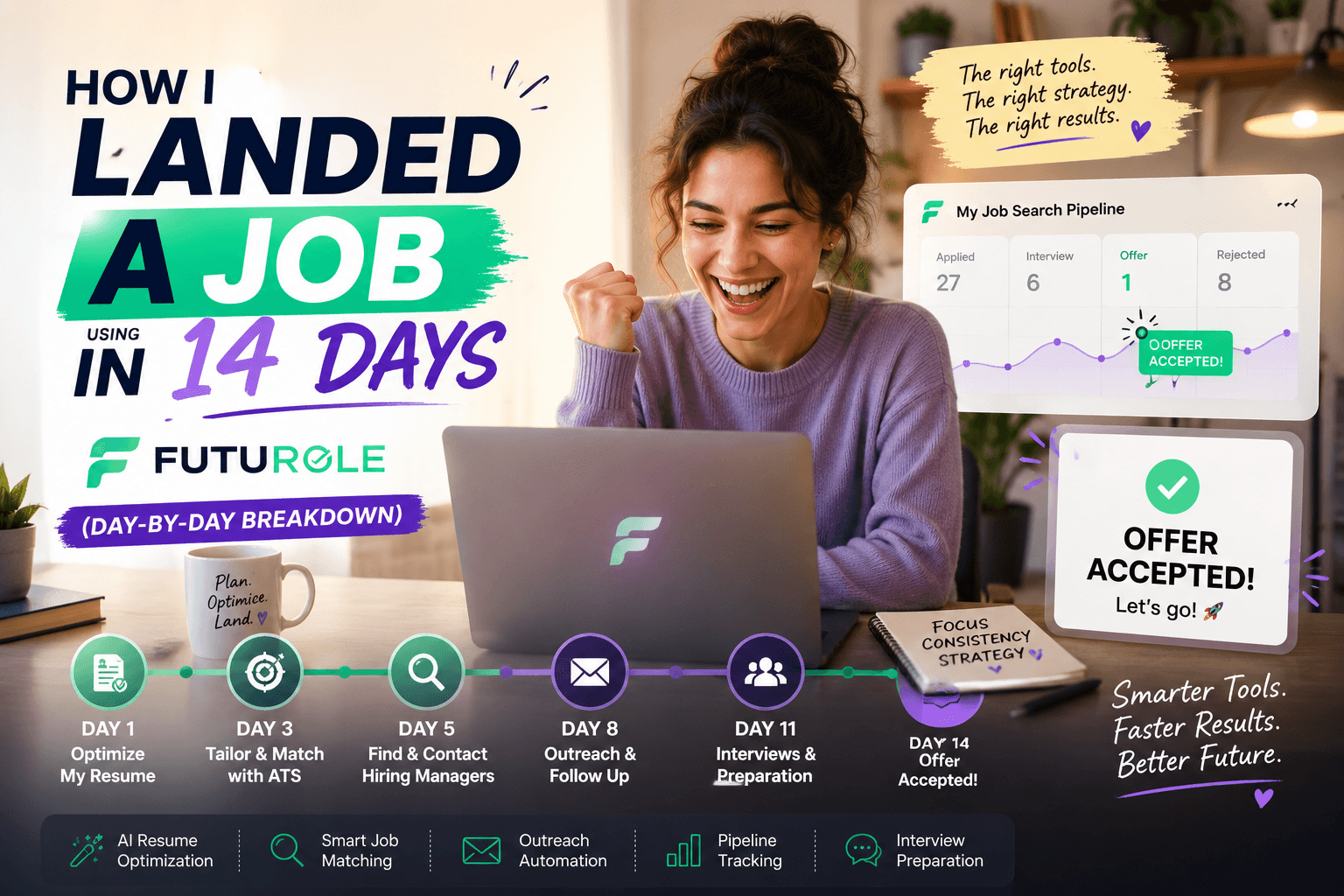
What follows is Priya's story — a composite account based on real patterns we observe among FutuRole users. Names, employer details, and some specifics have been adjusted for privacy. The timeline, feature usage, metrics, and outcomes are representative of what the FutuRole pipeline produces when implemented consistently.
On a Tuesday morning in late March 2026, Priya Nair sat at her kitchen table in Austin, Texas, staring at her laptop. She had been job hunting for four months. She had sent 183 applications. She had received 6 automated rejections and 177 silences.
She had a master's degree in data analytics from UT Austin and four years of experience as a data analyst at a mid-size logistics company. She knew SQL, Python, Tableau, and dbt. She had rebuilt her company's entire reporting infrastructure. She had saved her team an estimated 12 hours per week in manual reporting. By any objective measure, she was a strong candidate.
The market didn't seem to agree.
What Priya didn't know — yet — was that her job search wasn't broken because of who she was. It was broken because of how she was running it. She had the right experience, the wrong system.
On that Tuesday morning, she signed up for FutuRole. Fourteen days later, she signed an offer letter.
This is the exact, day-by-day breakdown of what she did.
Before Day 1: The Diagnosis
Before Priya changed anything, she needed to understand what was actually broken. Her first action on FutuRole wasn't applying to a single job. It was running a diagnostic.
She took three job descriptions she'd already applied to — roles she'd felt genuinely qualified for, at companies she'd been excited about — and ran her existing resume through FutuRole's free ATS Scanner against each one.
The results were clarifying and uncomfortable.
Role 1 — Senior Data Analyst, B2B SaaS (Austin, Remote-first): ATS match score: 41%. Missing keywords: "dbt Cloud," "data modeling," "self-serve analytics," "stakeholder reporting," "data governance." Priya had done all of these things. Her resume used different language for all of them.
Role 2 — Analytics Engineer, FinTech Startup (Remote): ATS match score: 38%. Missing: "ELT pipelines," "data warehouse," "Snowflake," "looker," "business intelligence." She'd worked with Snowflake for two years. The word didn't appear once on her resume.
Role 3 — Data Analyst II, HealthTech Company (Austin): ATS match score: 67% — the only one above the typical ATS advancement threshold of 60-70%. It was also the only role where she'd received any kind of human response: a form email saying her application was "under review."
The pattern was unmistakable. According to BLS JOLTS data from March 2026, 6.9 million job openings remained active with 5.6 million hires completed that same month — the market wasn't frozen. Priya's applications were just invisible to the machines that gatekept access to it.
Her average ATS match score across her 183 previous applications: she estimated it was somewhere between 40 and 50%. She had been systematically filtered out before any human ever read her name.
The problem wasn't her experience. It was translation.
Day 1–2: Building the Foundation
Feature used: AI Resume Engine + ATS Scanner
Priya spent the first two days doing something counterintuitive: she didn't apply to a single job. She rebuilt her resume from scratch.
Not the structure. Not the formatting. Just every bullet point.
Using FutuRole's AI Resume Engine as a starting scaffold, she went through each role and applied one rule: if a bullet point described what she was responsible for, she rewrote it around what she actually produced.
Here's what that looked like in practice across three of her most important bullets:
Before:
Responsible for building and maintaining data pipelines for the operations team
After:
Architected and maintained 14 ELT pipelines in dbt Cloud processing 2.3M daily records, reducing data latency from 6 hours to 22 minutes and enabling real-time operational dashboards for 3 departments
Before:
Created dashboards and reports for leadership
After:
Built a self-serve analytics suite in Tableau used by 40+ non-technical stakeholders, eliminating 12 hours/week of manual reporting requests and reducing ad-hoc data turnaround from 3 days to same-day
Before:
Helped improve data quality processes
After:
Designed and implemented a data governance framework covering 18 critical tables, reducing data quality incidents from ~9/month to fewer than 2 — cited directly in the Q3 2025 board presentation as an operational improvement
The numbers came from Priya's memory, her performance reviews, and one Slack message from her VP that she'd bookmarked because it mentioned the pipeline improvements. None of it was fabricated. It had simply never been written down in a form that communicated its value.
As ABR Jobs' 2026 resume tailoring guide notes: "Reduced assembly errors is vague. Reduced assembly errors by 23% through revised quality checkpoints, preventing $47K in rework costs — that demonstrates impact." The same logic applies to data work. Results make experience real.
After the rebuild, Priya ran her new base resume against the same three job descriptions she'd tested at the start.
New scores: 72%, 69%, 81%.
She hadn't applied to a single job. She'd moved her average match score from ~41% to ~74% by rewriting bullets she should have written years ago.
The foundation was ready. Now the system could begin.
Day 3–4: Building the Target List
Feature used: Company Intelligence + Chrome Extension
On Day 3, Priya stopped browsing job boards the way she'd been doing for four months — searching "data analyst Austin" and scrolling through hundreds of listings, applying impulsively to anything that looked relevant.
She replaced that with a targeting process.
Using FutuRole's Company Intelligence, she researched every company she considered before applying. The feature surfaces hiring velocity (how many roles a company has open and how recently they were posted), funding history, team growth signals, recent news, salary ranges, tech stack, and Glassdoor culture scores.
She set three filters for herself:
- Company had posted at least 3 roles in the last 30 days (signal of active hiring momentum, not ghost posting)
- Funding announced within the last 18 months OR revenue-stage company with positive growth signals
- Data team size visible on LinkedIn between 5 and 25 people (small enough to need senior contributors, large enough to have structure)
This eliminated roughly 60% of the roles she would previously have applied to blindly. What remained was a list of 22 companies that showed genuine hiring momentum.
She also installed FutuRole's Chrome Extension on Day 3. From that point forward, any time she browsed LinkedIn Jobs or Indeed and found a role that met her criteria, one click saved it to her FutuRole pipeline and automatically pre-populated the company intelligence, the job description, and a draft tailored resume — without her opening a separate tab.
Data from Teal's analysis of 14,500 successful job seekers shows that "the key is being selective — successful job seekers applied to roughly half the jobs they saved, focusing on roles where they were genuinely a strong fit." Priya was now applying that principle systematically rather than by gut feel.
By end of Day 4, she had a shortlist of 11 roles at companies with real hiring signals, all posted within the last 72 hours.
Day 5–7: The Tailoring Engine
Feature used: AI Resume Engine (full tailoring mode)
Days 5 through 7 were application days. For each of the 11 roles on her shortlist, Priya ran FutuRole's AI Resume Engine in full tailoring mode: paste the job link, review the tailored output, make two or three manual adjustments for tone and authenticity, export as ATS-ready PDF.
Time per application: 9 minutes on average, down from the 35-40 minutes she'd been spending previously.
The tailoring wasn't cosmetic. For each role, FutuRole adjusted:
- Keywords in the skills section to mirror the exact terminology of the job description (not paraphrases — exact matches, because ATS systems don't handle synonyms reliably)
- Bullet point framing to lead with the most relevant achievement for that specific role (the data governance bullet led for compliance-heavy HealthTech roles; the pipeline latency bullet led for engineering-focused analytics roles)
- The professional summary to use the role's specific language and mention the company's tech stack where it overlapped with Priya's experience
- Skills ordering to put the most-mentioned technologies from the job description first
As scale.jobs' 2026 job search strategy analysis confirms: "Tailored, high-quality applications are the key to landing interviews in today's job market" — with personalized applications producing response rates of 15-20% versus 1-2% for generic submissions.
After tailoring, Priya ran each version through the ATS Scanner one final time before submitting. She didn't submit a single application below a 74% match score.
Applications submitted Days 5-7: 11 Average ATS match score: 81% Time spent on tailoring: 99 minutes total
Day 5–7 (Parallel): The Outreach Layer
Feature used: Contact Intelligence
Simultaneously with submitting each application, Priya used FutuRole's Contact Intelligence to find the hiring manager or senior recruiter behind each posting. For 9 of the 11 roles, FutuRole surfaced a verified name and contact — either a LinkedIn profile with messaging enabled or a professional email address.
She sent a message to each one the same day she submitted her application.
Her template, refined after two test messages on Day 5:
Hi [Name] — I just submitted my application for the [Role] and wanted to reach out directly. I spent the last 4 years building the data infrastructure at [Previous Company] — including a dbt pipeline rebuild that cut reporting latency from 6 hours to 22 minutes. I'd love to bring that kind of approach to [Company Name]. Happy to share more context if useful.
Eighty-three words. One specific, quantified achievement. One soft ask with no pressure.
She sent 9 messages total. She heard back from 4 within 48 hours.
One recruiter replied: "I saw your application come through — I'll flag it for [hiring manager] today." One hiring manager replied: "Impressive pipeline work. Let's find 20 minutes." Two others acknowledged receipt and said they'd be in touch after reviewing.
As FastApply's 2026 job search guide notes: "Cold applications have a 0.1-2% success rate. Referrals have a 30% success rate." Direct outreach to a hiring manager sits somewhere between the two — and it produces results that generic portal applications simply cannot.
The combination of a high ATS match score (ensuring she appeared in the formal review queue) and direct outreach (ensuring a human knew her name before the queue was sorted) was the double-entry strategy that changed everything.
Day 8: The First Interview Request
On Day 8, Priya's inbox moved.
8:14 AM: A calendar invite from a Series B data infrastructure startup in Austin — 30-minute intro call with the Head of Data, scheduled for Day 10.
11:47 AM: A reply from the HealthTech company's recruiter: "We reviewed your application and would love to schedule a technical screen. Are you available this week?"
3:22 PM: The hiring manager she'd messaged directly at a fintech company forwarded her note to the VP of Analytics with the comment: "Worth a look — solid dbt background." The VP's EA reached out 40 minutes later to schedule a call.
Three interview requests. Day 8. After four months of silence.
Priya noted the timing in her FutuRole tracker: all three contacts came within 72 hours of her direct outreach messages landing. None came through the portal alone.
Day 9: Activating the Preparation Pipeline
Feature used: Company Intelligence + AI Voice Interview Coach
With three interviews scheduled across Days 10-12, Priya used Day 9 entirely for preparation.
First, she went back into FutuRole's Company Intelligence for each of the three companies — not for the surface-level hiring signals she'd used for targeting, but for the deeper layer: recent product announcements, leadership LinkedIn posts about team priorities, Glassdoor themes around the data team's current challenges, tech stack specifics.
For the Series B startup, Company Intelligence surfaced a LinkedIn post from the Head of Data from 3 weeks prior: "We're rebuilding our data platform from scratch — looking for someone who's done this before and has the scars to show for it."
Priya made a note. That exact phrase — "rebuild from scratch" and "scars to show for it" — shaped how she framed her experience in the interview. Instead of describing her pipeline work generically, she opened with: "I've done a full infrastructure rebuild once. I can tell you exactly what breaks, what you wish you'd designed differently, and what I'd do again." The hiring manager later told her it was the moment he knew she understood the role.
She spent the rest of Day 9 with FutuRole's AI Voice Interview Coach — running three 20-minute practice sessions, one for each company's context. The Voice Coach asked her role-specific questions, followed up on her answers with probing questions ("You mentioned the latency improvement — what broke first when you started the rebuild?"), and scored her answers on structure, specificity, and clarity.
After each session, the debrief flagged the same recurring issue: Priya was front-loading context before getting to the point. She was spending 45 seconds of setup before the actual answer began. The debrief showed her the pattern across three questions. She fixed it before the real interviews started.
According to Enhancv's job search planning guide, "Day 14: Prepare for upcoming interviews by rehearsing STAR method responses" is a key milestone — but Priya had done this on Day 9, giving her answers time to become fluent rather than rehearsed before any actual interview.
Days 10–12: Three Interviews, Three Different Games
Day 10 — Series B Data Startup (30-minute intro with Head of Data)
Priya opened with the rebuild framing she'd prepared the night before. The conversation ran 47 minutes. The Head of Data asked if she could do a technical screen the following week. She said yes. He scheduled it before the call ended.
Day 11 — HealthTech Company (technical screen, 60 minutes)
The technical screen included two SQL problems, a case study on data modeling for a patient journey dataset, and a discussion of her approach to data governance. She solved both SQL problems cleanly. The data modeling case was harder — she got the structure right but missed an edge case. She caught it herself mid-explanation, corrected it, and noted what she'd do differently. The interviewer later told her recruiter that catching your own mistake in real time was "exactly the kind of thinking we need."
Day 12 — Fintech Company VP of Analytics (30-minute call)
This was the conversation that came from the direct outreach. The VP opened with: "Your background looks strong on paper — tell me what you'd want to build if you were here." Priya had prepared a specific answer using the Company Intelligence layer: she'd read their job description carefully, found a LinkedIn post about their struggles with self-serve analytics adoption, and had a concrete answer ready about what she'd prioritize in the first 90 days.
The call ran 40 minutes. The VP said he'd be in touch after the week's other interviews.
Day 13: Tracking, Following Up, Staying Organized
Feature used: Application Tracker
By Day 13, Priya had 3 active interview processes, 2 applications still pending review, and 6 that had gone quiet. She also had FutuRole's follow-up reminders firing for the 4 hiring managers who had replied to her outreach but not moved to a formal interview yet.
She sent two follow-ups that day — both under 60 words, both specific:
Hi [Name] — I wanted to follow up on my application for [Role]. I had a great first interview with [other company] this week that's reminded me how much I'd enjoy this kind of work at [Company]. Still very interested if timing works on your end.
One didn't respond. One did — and scheduled a call for Day 15.
The FutuRole Application Tracker's Kanban board gave Priya a clear view of where everything stood: which stage each process was in, which follow-ups were due, and which companies had gone cold. In four months of previous job searching, she had lost track of at least a dozen applications she'd meant to follow up on. In 14 days with a structured tracker, nothing slipped.
Day 14: The Offer
At 4:47 PM on Day 14, Priya's phone rang. It was the recruiter from the HealthTech company.
The offer: Senior Data Analyst, $118,000 base + equity + remote-first. $14,000 above her previous salary. No commute. A team of 8 analysts working on a product she'd used herself.
She asked for 48 hours to consider. The recruiter said yes.
She used those 48 hours to accelerate the conversations with the startup and the fintech company — letting both know she had an offer and asking about their timelines. The startup fast-tracked her to a final technical call. The fintech company's VP said they weren't ready to move that quickly.
Priya signed the HealthTech offer on Day 16.
The Full 14-Day Breakdown
Here is the complete sequence with the specific FutuRole features that drove each stage:
| Day | Action | FutuRole Feature | Outcome |
|---|---|---|---|
| Pre-Day 1 | ATS audit of existing resume | ATS Scanner | Discovered 41% average match score |
| 1–2 | Complete resume rebuild | AI Resume Engine | Average score jumped to 74% |
| 3–4 | Company research + targeting | Company Intelligence | Identified 11 real opportunities from 22 companies |
| 3 | Job capture workflow | Chrome Extension | One-click pipeline for all new postings |
| 5–7 | Tailored 11 applications | AI Resume Engine | 9 min/application, avg score 81% |
| 5–7 | Hiring manager outreach | Contact Intelligence | 9 messages sent, 4 responses within 48h |
| 8 | First interview requests | — | 3 requests on Day 8 |
| 9 | Deep company research | Company Intelligence | Role-specific framing for each interview |
| 9 | Interview preparation | AI Voice Interview Coach | Fixed answer pacing before real interviews |
| 10–12 | Three interviews | — | Advanced in all three processes |
| 13 | Follow-ups + pipeline review | Application Tracker | 2 follow-ups sent, 1 new call scheduled |
| 14 | Offer received | — | $118K, remote-first, $14K above previous salary |
What Made the 14-Day Timeline Possible
Most job searches don't take 14 days. The average is 3 to 6 months, and Teal's data on 14,500 job seekers who tracked their search through to an offer found that "most successful job seekers landed an offer within about 2 months of consistent effort." Fourteen days is on the fast end of what's possible — and it required four things to align simultaneously.
1. A strong base resume, rebuilt correctly. Without the achievement-based rewrite on Days 1-2, nothing else in the pipeline would have worked. The tailoring engine is only as good as the material it starts with. This is the non-negotiable foundation.
2. Precision targeting over volume. Priya applied to 11 jobs in 14 days. Not 183. The Company Intelligence layer meant each application went to a company that was genuinely hiring — not a ghost job, not a frozen headcount, not a posting that had been live for 6 weeks with no movement.
3. The double-entry strategy. Every application was paired with direct outreach to the hiring manager. The ATS ensured she appeared in the formal review queue. The outreach ensured a human knew her name before the queue was sorted. Both channels working together produced results that neither would have produced alone.
4. Preparation before the interviews arrived. The Voice Interview Coach on Day 9 fixed a pattern in her answers before it cost her anything real. Most candidates discover their weaknesses in actual interviews. Priya discovered hers in practice.
The Honest Caveat
Priya's timeline was fast. Not everyone gets an offer in 14 days — and it would be dishonest to suggest otherwise. Industry, seniority level, location, and market conditions all affect timelines in ways no tool can fully control.
What FutuRole controlled was everything in Priya's power to control: the quality of her resume, the precision of her targeting, the consistency of her outreach, the depth of her interview preparation, and the organization of her pipeline. Those are the variables that determine whether a job search takes 2 weeks or 6 months — and they're the ones that most job seekers manage poorly.
As ResumeVera's 2026 fast-hire analysis puts it: "The bottleneck is not the market. It is whether your resume passes automated screening and reaches the right recruiters fast enough to generate callbacks."
The market has 6.9 million open jobs. The bottleneck is the system between you and those jobs. That's what FutuRole fixes.
URL: futurole.com/blog/how-to-land-a-job-in-14-days
Ready to run your own ATS audit and start the pipeline? Try FutuRole free → — no credit card required.